
Location guide
31 Days in China
A month across China on the 30-day visa-free window: Macau to Shangri-La, 18 stops, roughly 6,000 km of high-speed rail, and the notes we actually used.
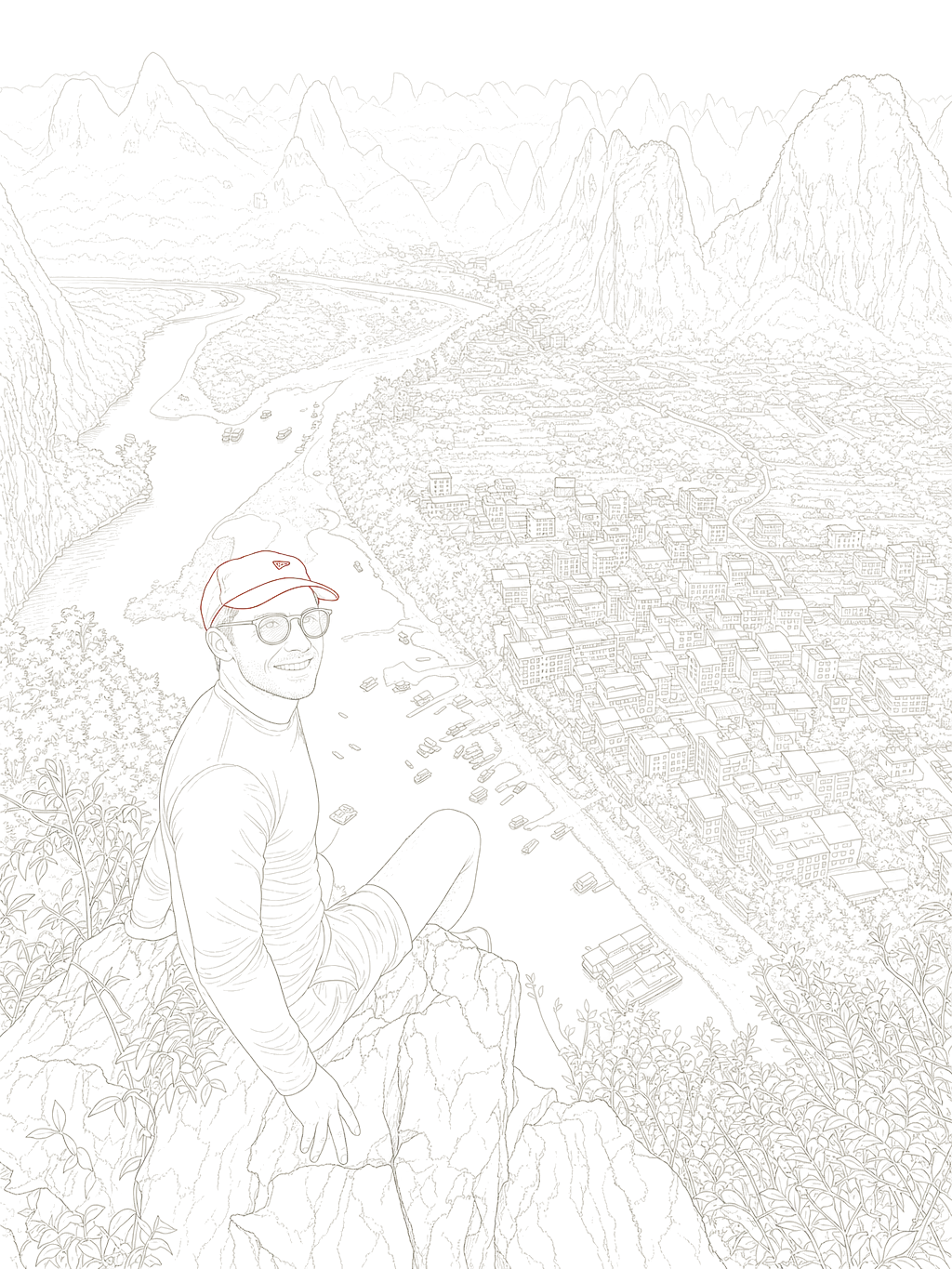
China gives a lot of Western passports 30 days visa-free now. No paperwork, no interview, just show up. That number set the shape of the whole trip: 30 days on the clock, one warm-up day in Macau, and a route that kept moving because it had to.
It was me and Esme for the month. Our friend James joined for the first week, and Glen and Jenny (plus their two girls) kept intersecting with us from Yangshuo all the way to Shanghai.
I expected the scale. I did not expect how well the whole machine works once you learn its rules. Trains at 300 km/h that leave to the second. A taxi app whose ETAs are so accurate that 40 minutes of rally driving saved us exactly one minute. Hotels where a robot rides the elevator to bring your delivery. And next to all of that: cash-only taxis, unfindable map pins, and pharmacies that would really rather sell you herbs.
The other thing nobody told me: Chinese tourists do not wake up early. That one fact, applied ruthlessly, gave us the Avatar Mountains, Huashan, the Stone Forest, and the Great Wall almost completely to ourselves.
The useful shape of the trip:
- The karst south: Macau, Shenzhen, the Li River, Chongqing, Zhangjiajie. Warm, cheap, spectacular.
- The big north: Xi’an, Huashan, Beijing, and a quiet stretch of the Great Wall at Jinshanling. Cold, imperial, worth it.
- Jiangnan and Yunnan: Shanghai down to Hangzhou, then fly west and run the Kunming to Shangri-La line until the visa runs out.
Start Here
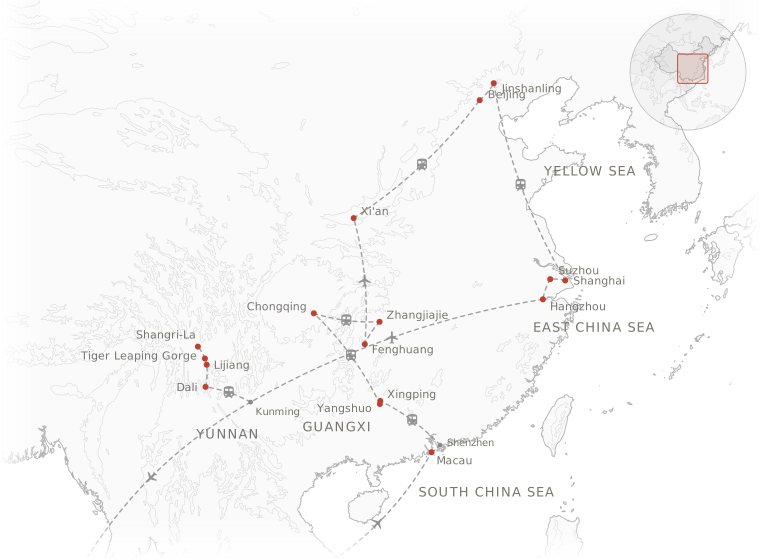
- Macau & the Pearl Delta 2 days Vegas cosplay, then the most futuristic afternoon of the trip in Shenzhen.
- Xingping & Yangshuo 4 days The 20 RMB banknote landscape. Scooters, top ropes, empty cableways at sunset.
- Chongqing 2 days A 30-million-person sci-fi city. Drone show, hotpot, train through a building.
- Zhangjiajie & Fenghuang 3 days The Avatar Mountains, beaten by waking up early. Two days is plenty.
- Xi'an & Huashan 4 days Huashan was the surprise best mountain of the trip. Warriors are a half day.
- Beijing & the Great Wall 4 days The city is fine. Jinshanling at sunrise and sunset is the whole reason to come.
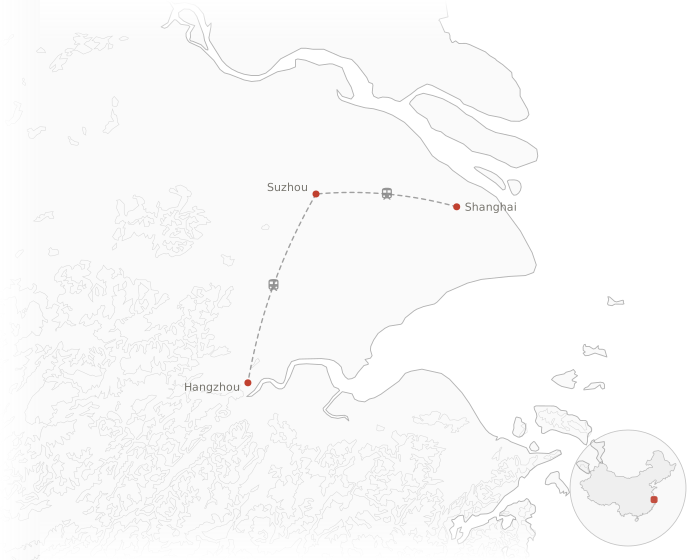
- Jiangnan 6 days Shanghai is China's only international city. Suzhou has the world's #2 barista.
- Yunnan 8 days Dali to Shangri-La is the leg we'd redo tomorrow. Book the sparse trains early.
Three rules carried the whole month:
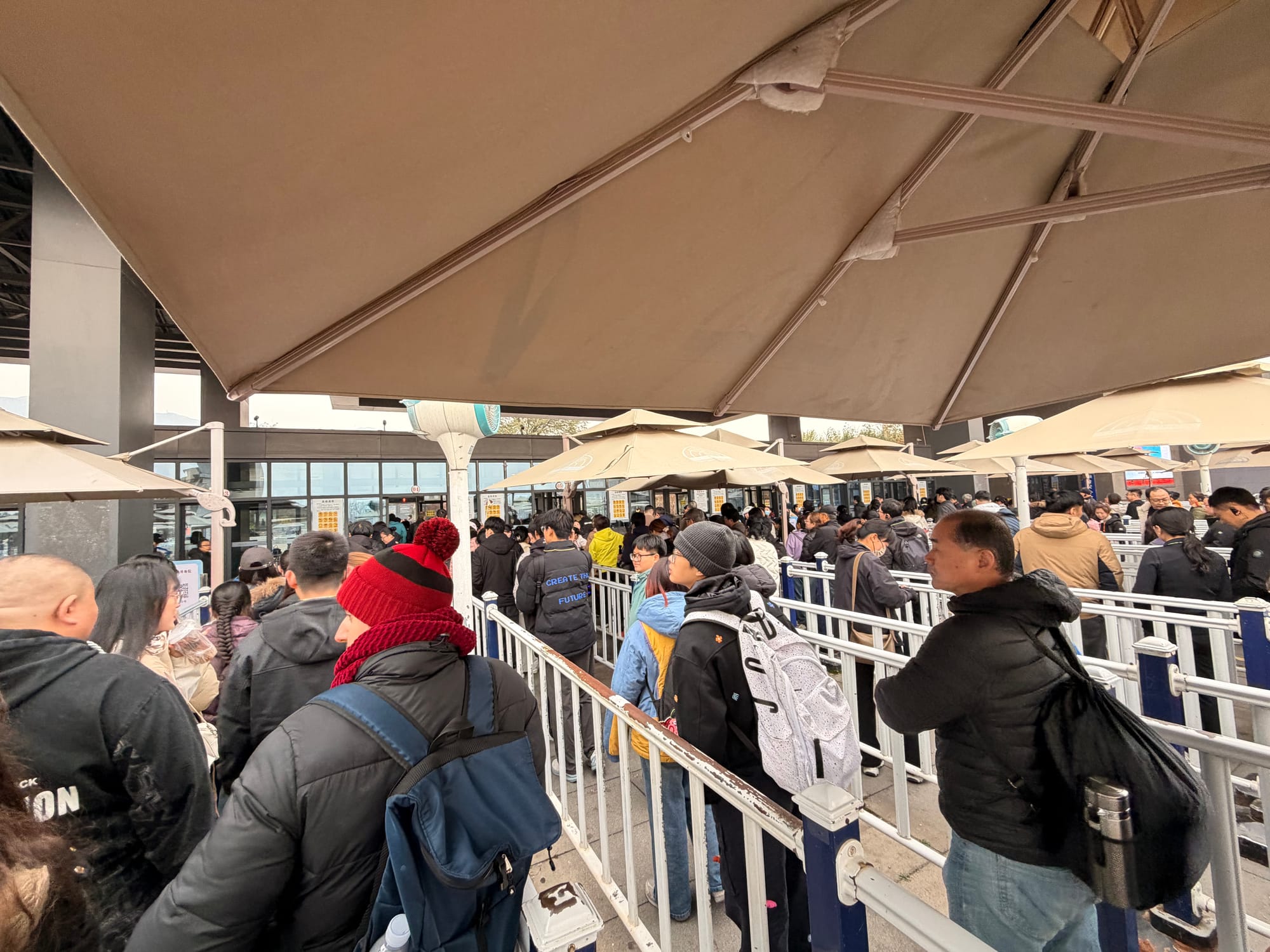
- Get there at opening. Tour groups arrive between 10:30 and 12. Before that, the most famous places in China are empty.
- Nature on weekdays, cities on weekends. Domestic tourism crushes the parks on Saturdays. Cities are busy every day anyway.
- Book everything on Trip.com. Trains, hotels, flights. It is the same company as Ctrip, it works in English, and free cancellation makes replanning painless. We changed plans constantly.
The Route
The same route, leg by leg.
LEG 01 · MACAU -> SHENZHEN
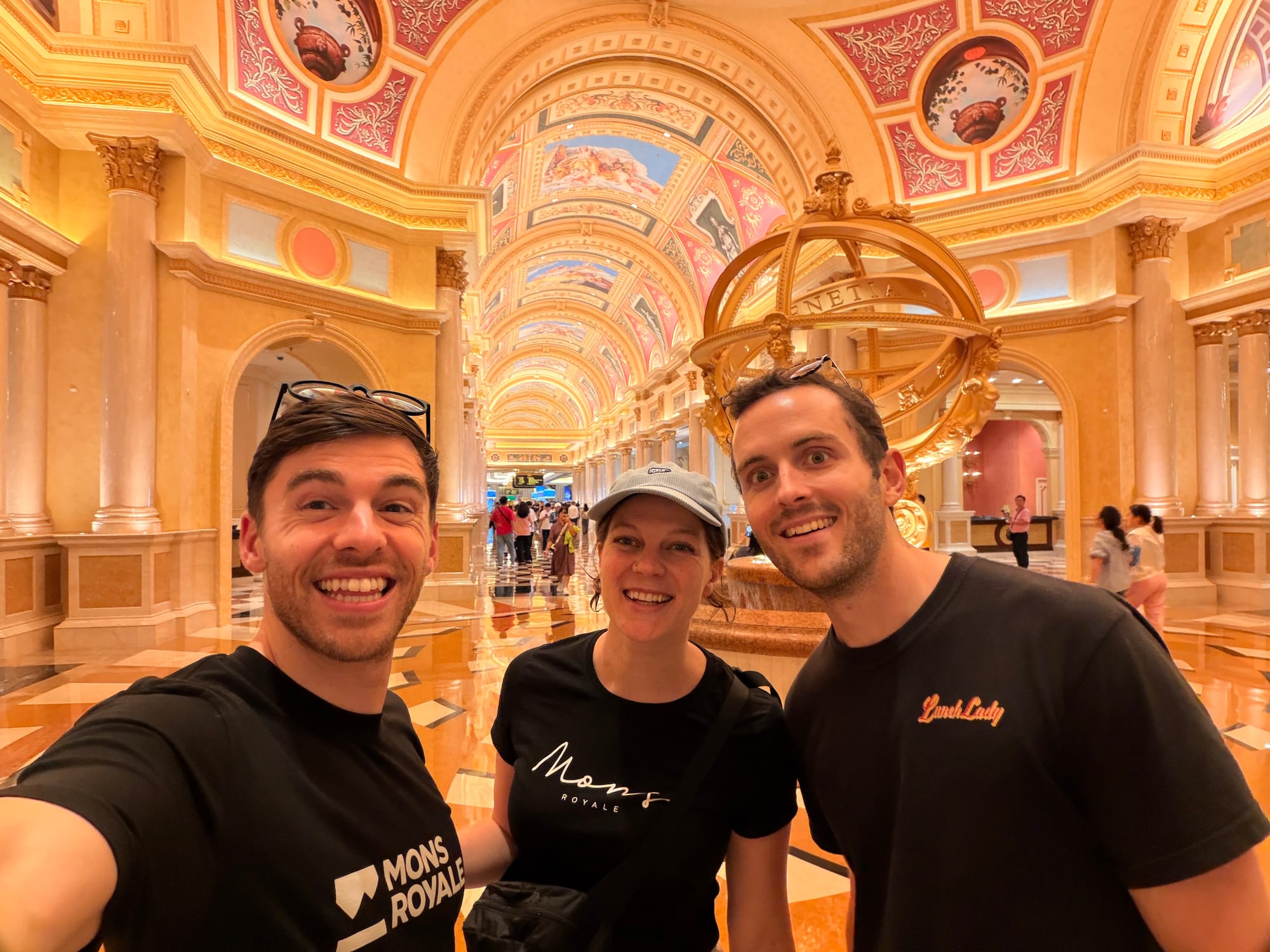
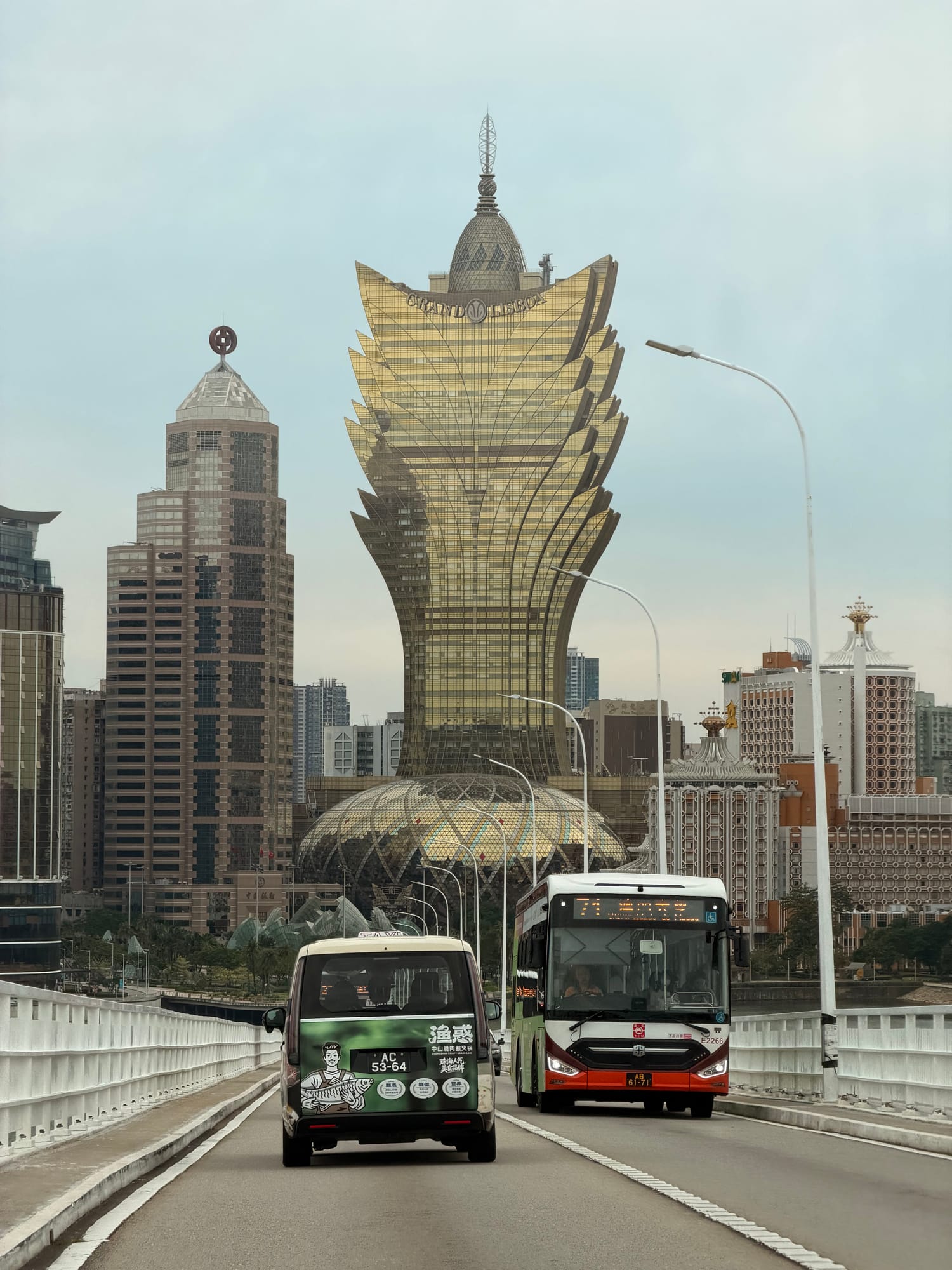
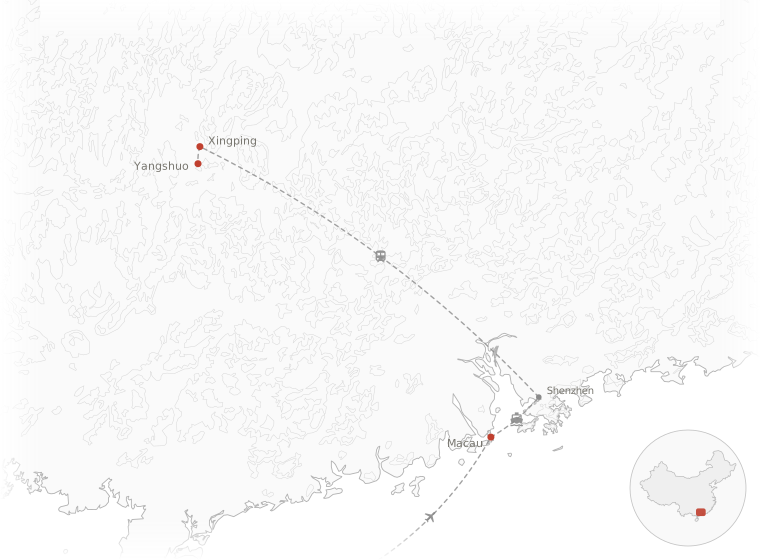
Land in Macau, where the taxis take only cash and the hotels are five-star for $100. Next morning: a $30 ferry to Shenzhen and an afternoon flying DJI's latest drone off a store balcony.
LEG 02 · NIGHT RUN TO XINGPING
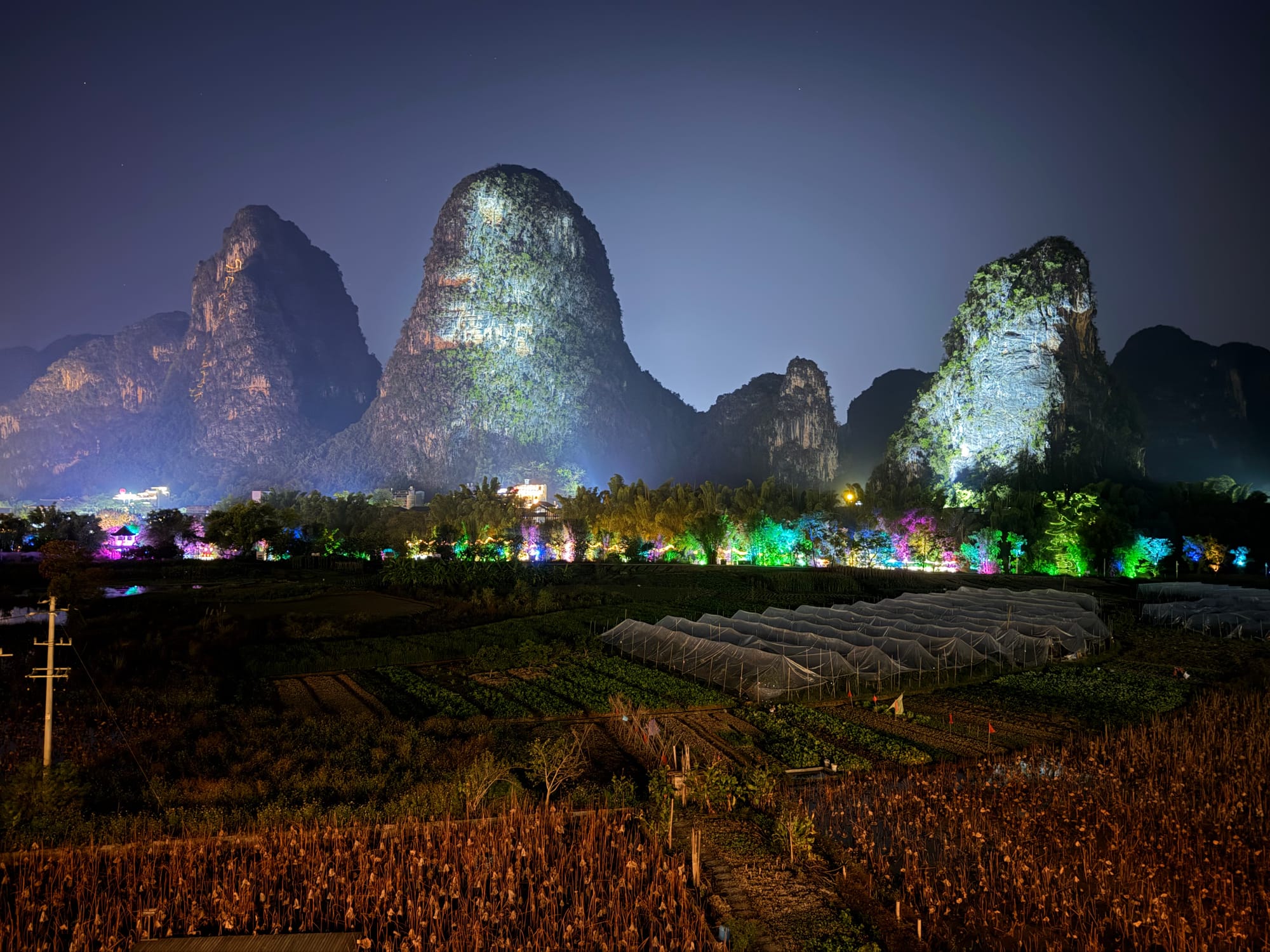
Evening bullet train into the karst, a wrong map pin, pot noodles for dinner. Worth it: we woke up inside the landscape printed on the 20 RMB note.
LEG 03 · YANGSHUO
Three days of scooters, outdoor climbing, and an empty cableway at sunset. The best stretch of the south.
LEG 04 · CHONGQING
A rally-driver Didi, a 4.5-hour train, and a sprint off the platform into an 18,000-drone show. Then two days in the most science-fiction city we have ever seen.
LEG 05 · THE HUNAN LOOP
At the park gates by 6:50am, the Avatar Mountains to ourselves, then a night in Fenghuang's lit-up river town. James peels off home.
LEG 06 · FLY TO XI'AN
Landed, cancelled the city hotel from a Starbucks, and slept at the foot of Huashan instead. The $16 homestay came with concierge service.
LEG 07 · NORTH TO THE WALL
Bullet train to Beijing's lake district, the Forbidden City, then a van 2.5 hours north to Jinshanling. Sunrise and sunset on the wall in one day. Peak of the trip.
LEG 08 · DOWN THE COAST
Shanghai for coffee flights and the fake market, Suzhou for gardens and the world's #2 barista, Hangzhou for West Lake at night.
LEG 09 · WEST TO YUNNAN
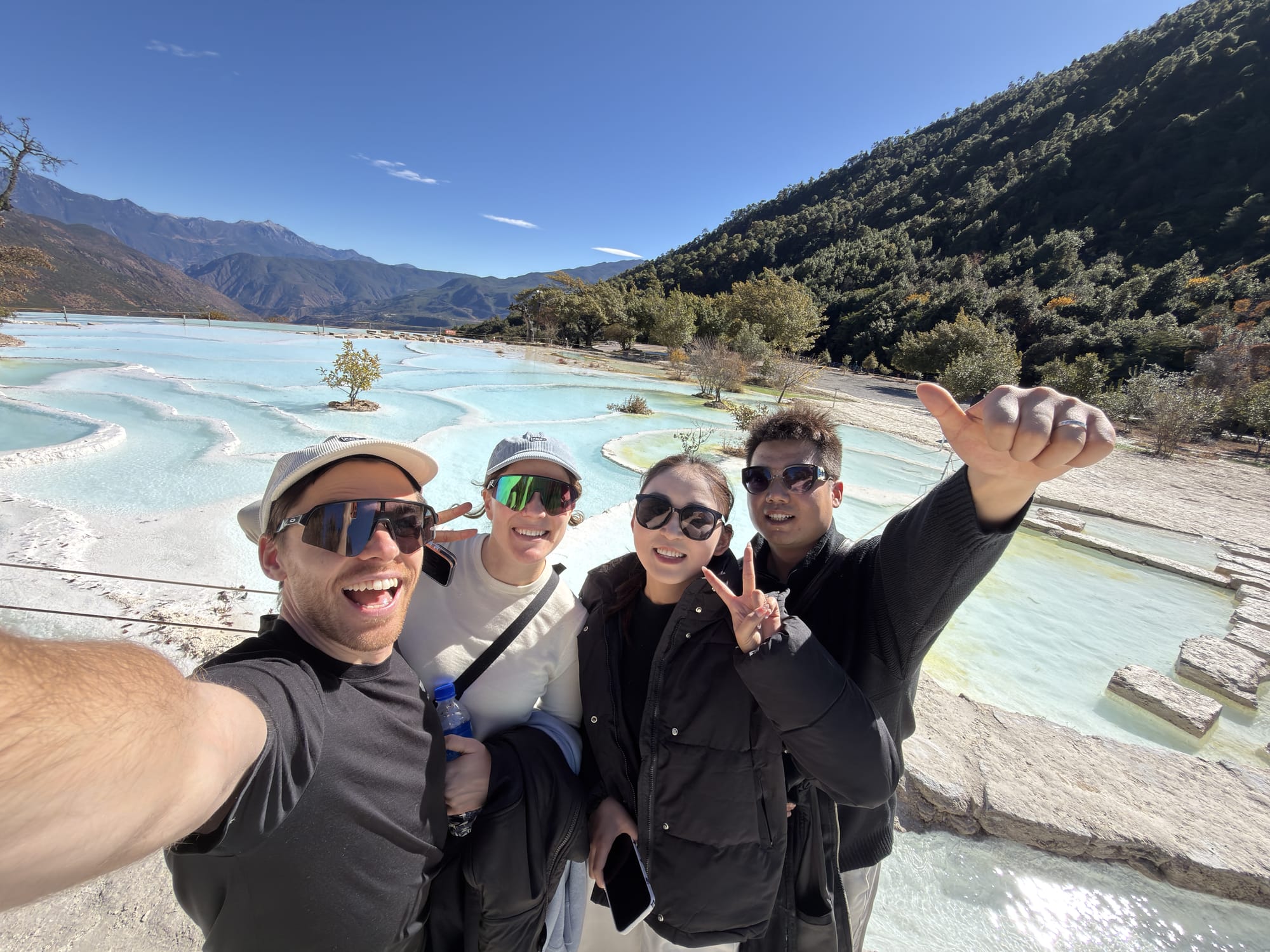
Fly to Kunming, walk into the Stone Forest at opening with the lights still off, then three slow days on Erhai Lake in Dali. The friendliest part of China.
LEG 10 · THE END OF THE ROAD
A dirt trail through Tiger Leaping Gorge at sunrise, a five-hour mystery detour, and yak hot pot at 3,200 m in Shangri-La. Day 30: the long train home.
LEG 11 · OUT
Back down the mountain: 5.5 hours of train from Shangri-La to Kunming, then a flight out to Bangkok on day 30 of the 30-day visa-free window. We used all of it.
Macau & the Pearl Delta
01 · Cash-only Vegas, then the future

One night of Vegas cosplay, one afternoon in the future. That ratio was right.
We flew Bangkok to Macau assuming we were landing in the world’s most cashless country. The taxi driver disagreed. Macau runs its own currency, the pataca, and the cabs take nothing else: no Alipay, no WeChat, no card. A woman from our five-star hotel ended up paying our fare out of her own pocket.
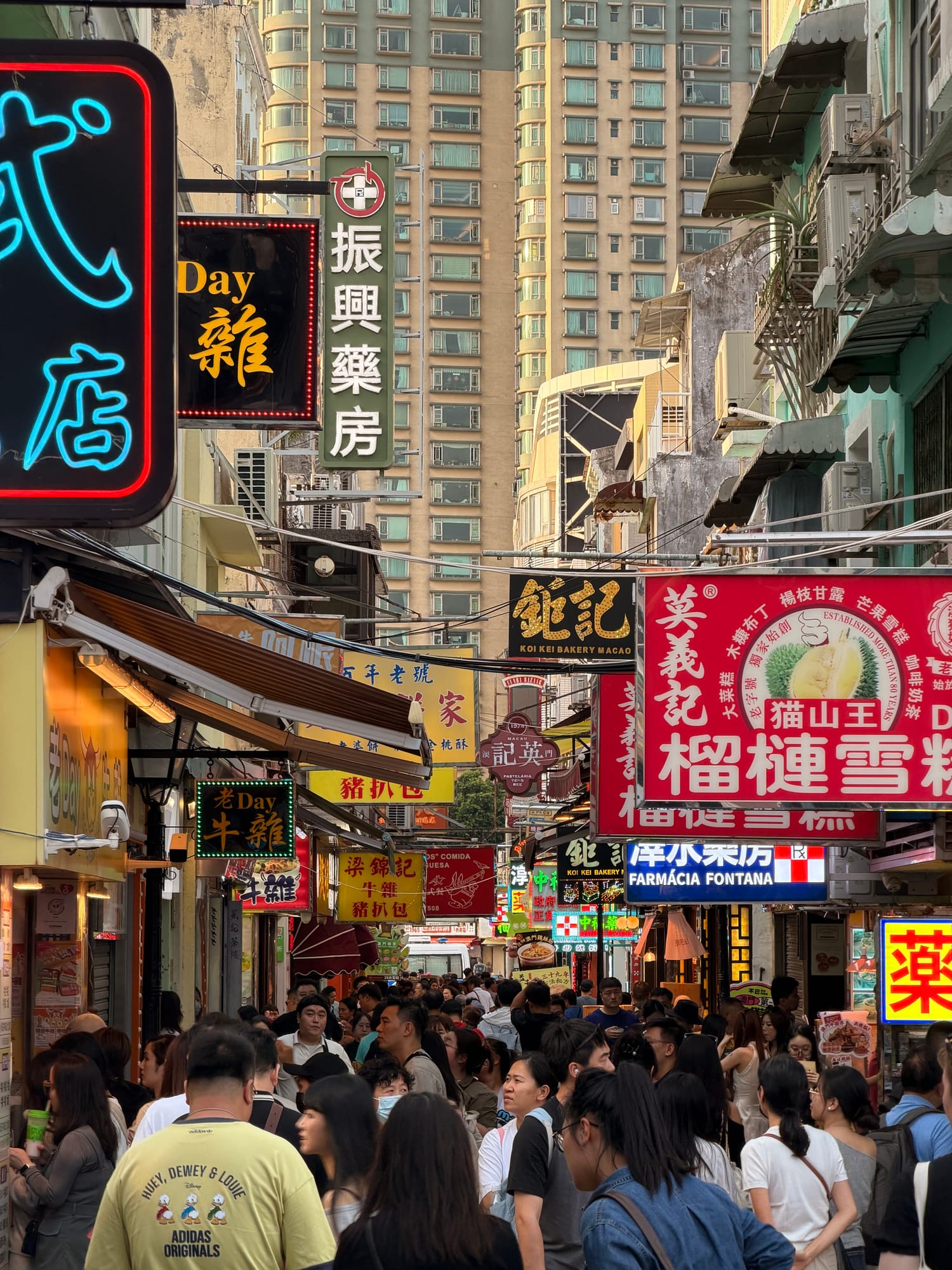
That hotel was the Andaz, and it cost about $100 a night. “It was Bangkok level but it only cost us 100 bucks. That was sweet.” The turn-down service tied up my loose cables with branded cable ties, which we kept using for the rest of the month. Then we walked the strip past the Londoner and the Parisian, a full Vegas cosplay with better dim sum.
The best meal in Macau was the opposite of all that: a tiny Macanese-Portuguese place run by one chatty lady cooking a four-course set menu solo. Halfway through, a power cut hit her building. She weighed her options, borrowed a countertop gas stove, and finished the meal on it. And it was great.
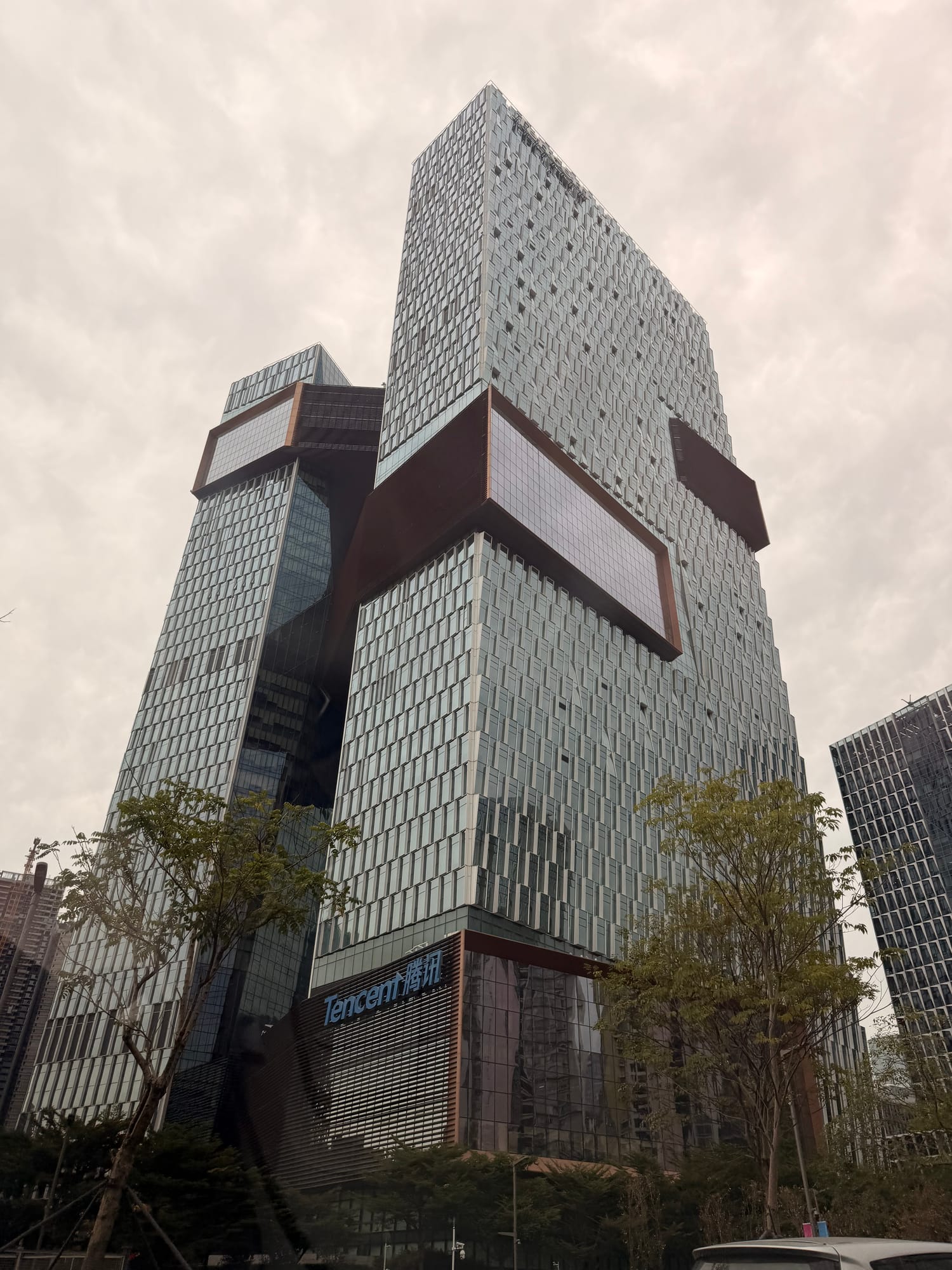
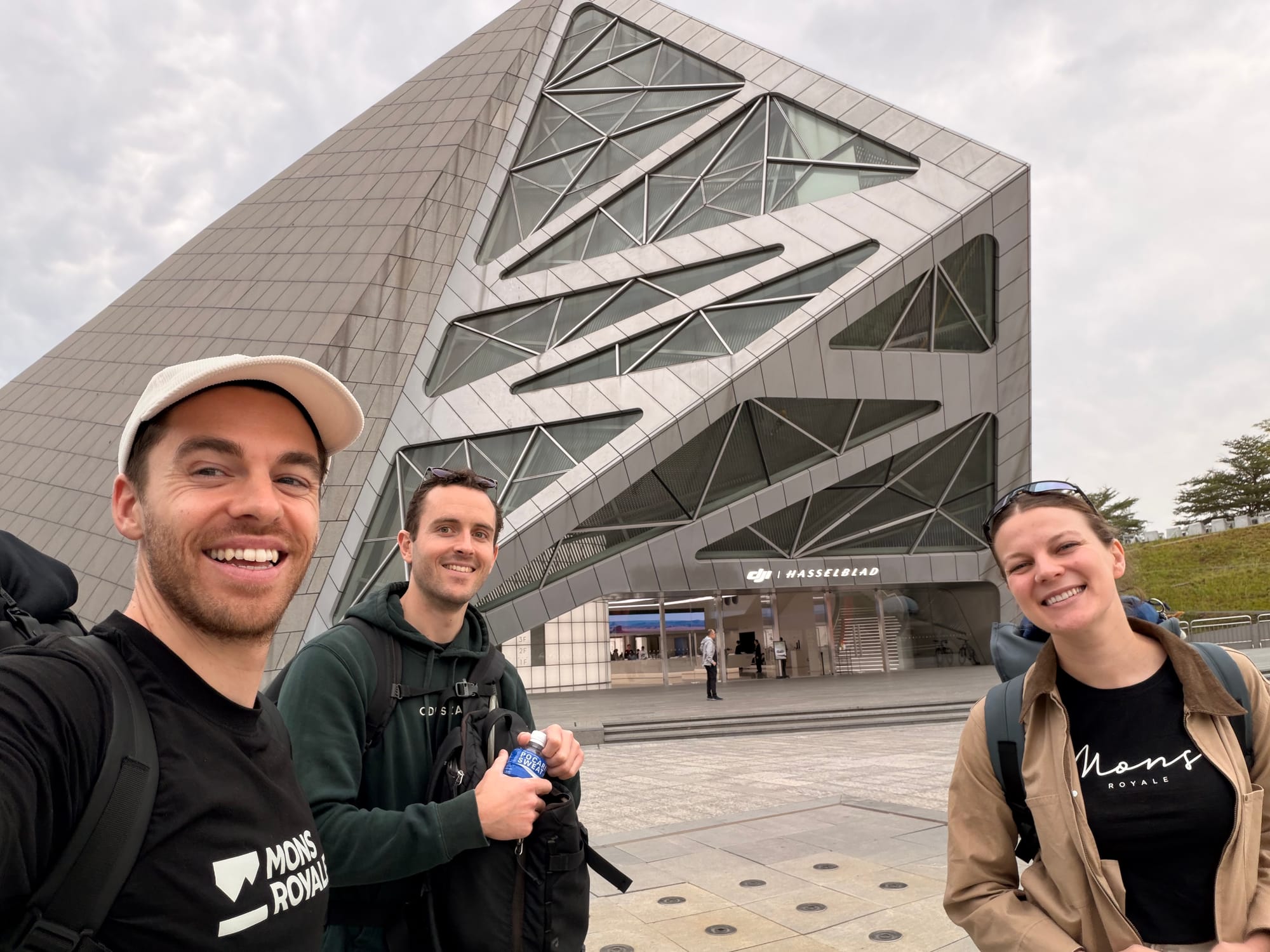
Next morning we took the $30 ferry to Shenzhen and spent one afternoon in the future. At the DJI flagship store, the guy handed me the controller for their latest drone off a second-floor balcony and asked exactly one qualifying question. It hit 90 km/h with a random stranger’s face locked in tracking. My honest takeaway, verbatim from that day: “It was pretty obvious to me how you could just swap out the camera for a gun. And the West is in trouble because China can make so many of these.” Same drone, 40 percent cheaper than in the US.
He was like, "you know how to fly?" And I was like, "yep," even when I didn't.
Then the Xiaomi store to sit in the car Apple never shipped, and seven minutes in the Huaqiangbei electronics market, where James bought “AirPods Pro 6” for $18. They don’t exist. They paired with Apple’s software anyway, pop-up animation and fake warranty screen included.
We sprinted to Shenzhen North expecting airport security and made the train with 20 minutes to spare, which it turns out is 15 minutes more than you need. By 10pm we were lost in Xingping’s dark old town because Apple Maps had the B&B in the wrong place, and dinner was pot noodles from a convenience store. Day two of thirty-one.
Chapter 01 / 08Day 2 of 31 · 5,600 km to go
The Karst South
02 · Living inside a banknote

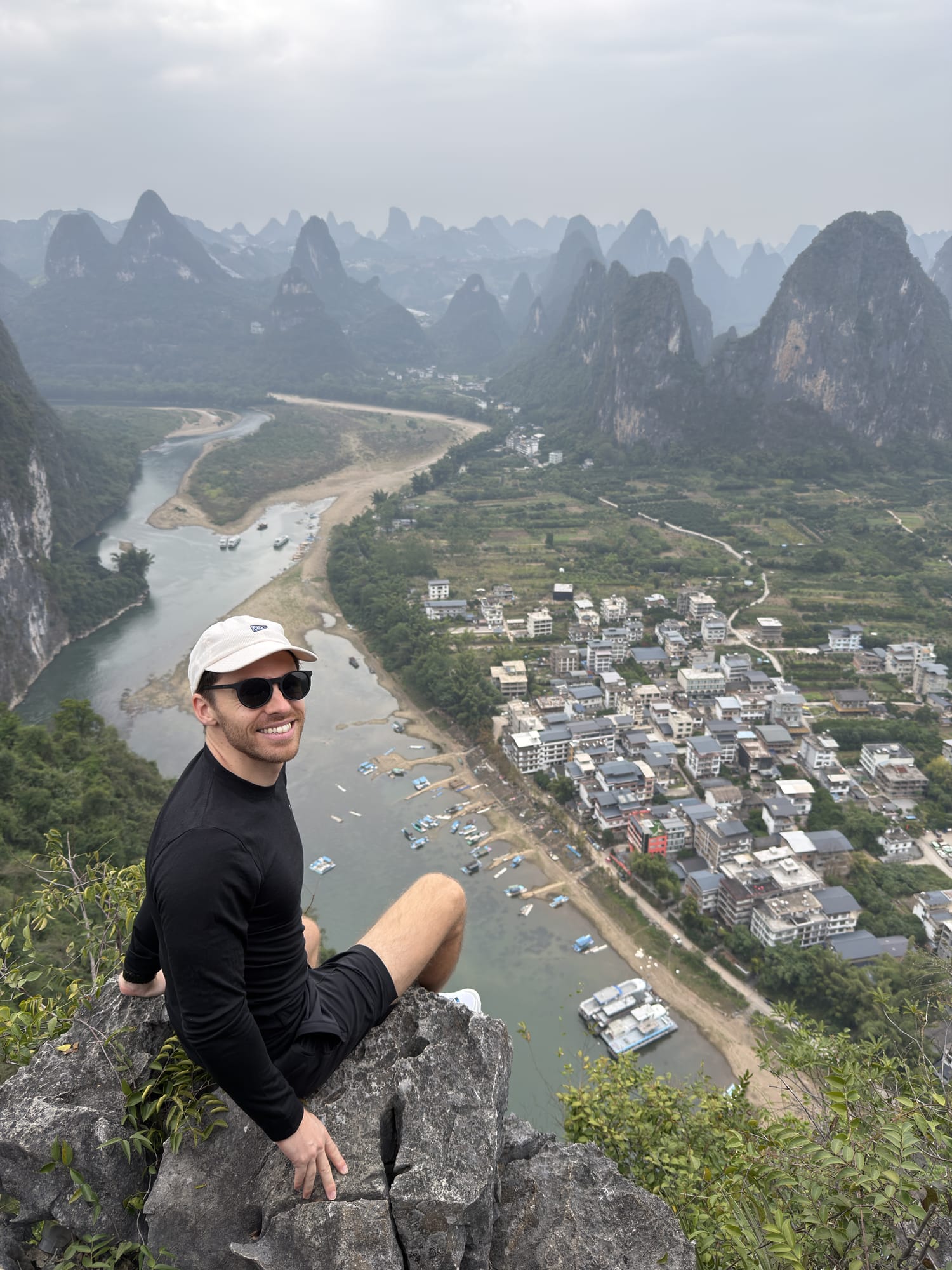
The 20 RMB banknote view is real, and at 5pm the cableways are empty.
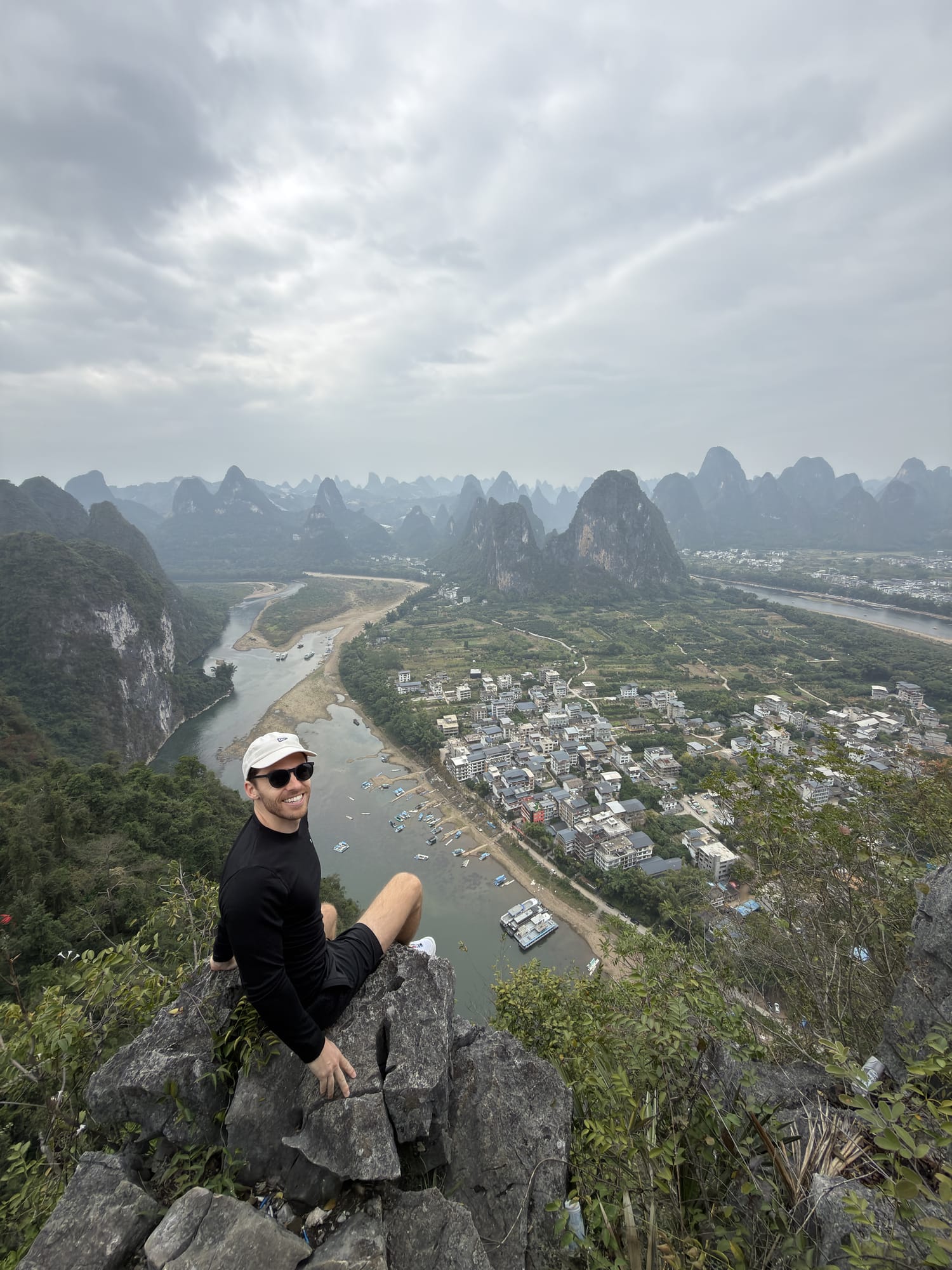
Xingping exists because of one view: the bend in the Li River that is printed on the back of the 20 RMB note. The climb up is 40 minutes of stairs (every “hike” in China is stairs, poured in concrete, built for volume), and the top is the rare famous thing that looks exactly like its picture.
The town itself gave us two running themes of the trip in one morning. First, the coffee: a one-woman Japanese-style cafe opposite our B&B pulled a genuinely great flat white, which set expectations the rest of China spent three weeks failing to meet. Second, the state: while we packed, two policemen walked in to check the homestay lady’s papers, minutes after James had been chatting away about the CCP and communism. “The atmosphere in the room really shifted.” Photos taken, everyone fine, comic timing impeccable.
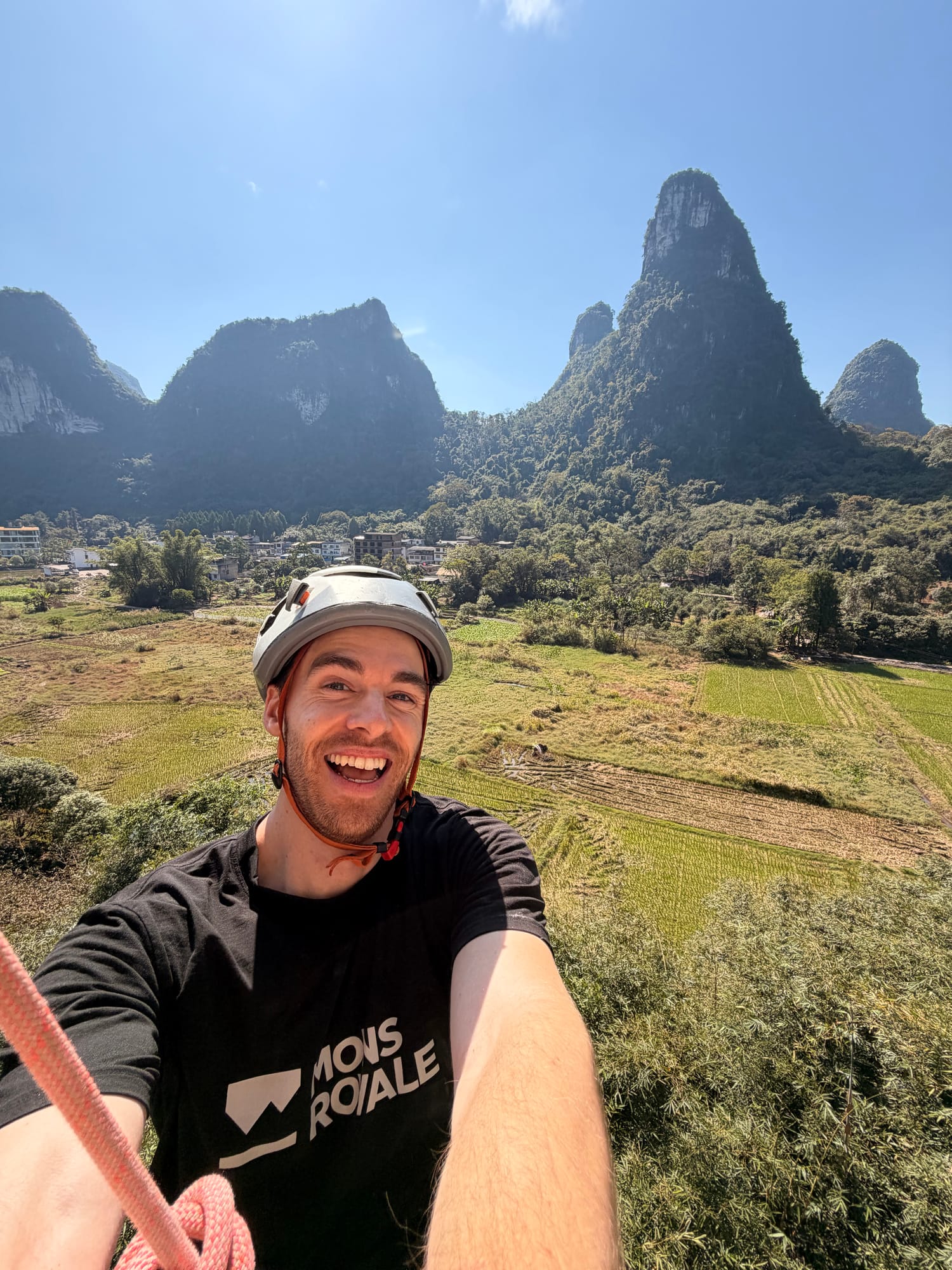
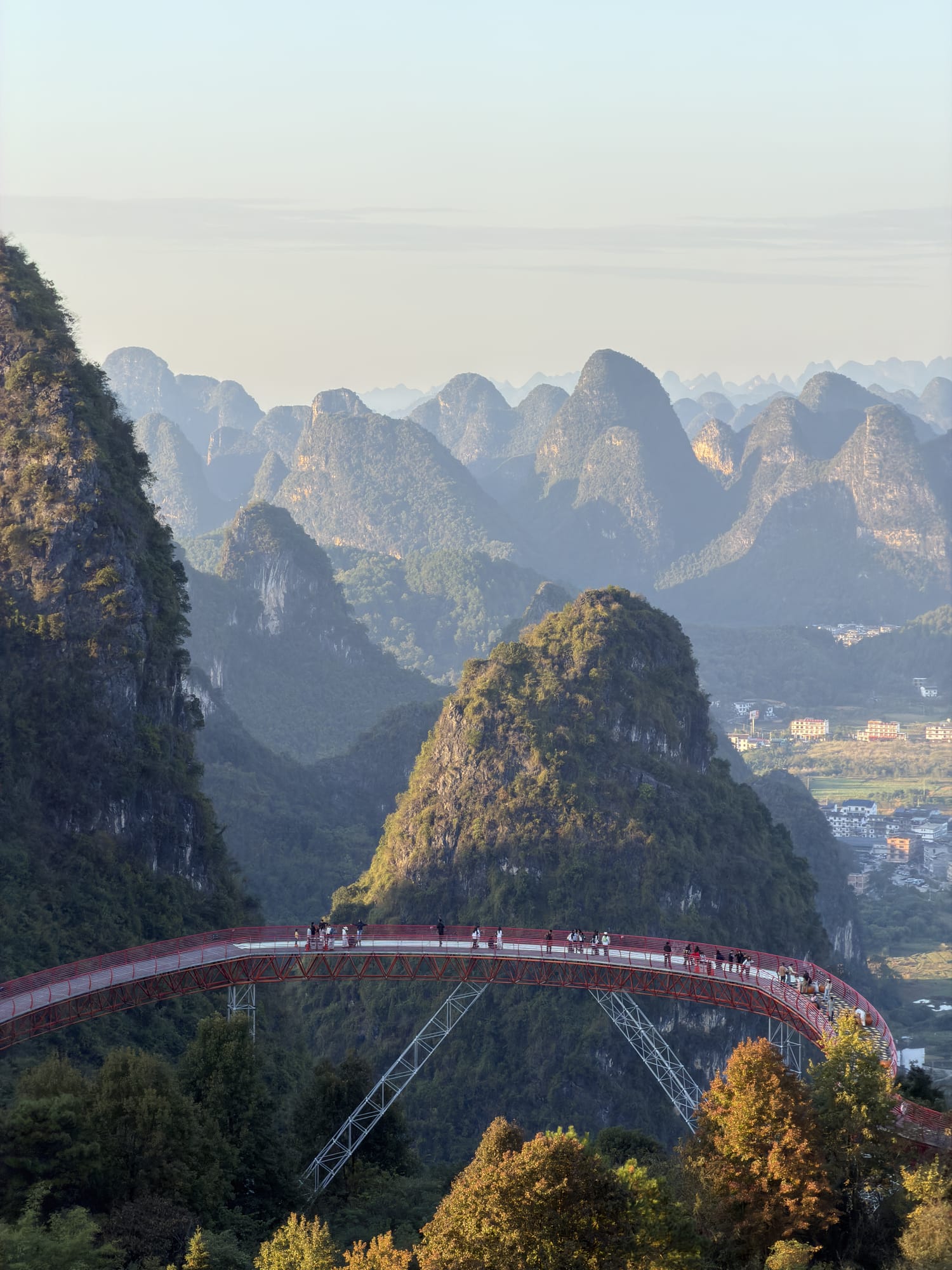
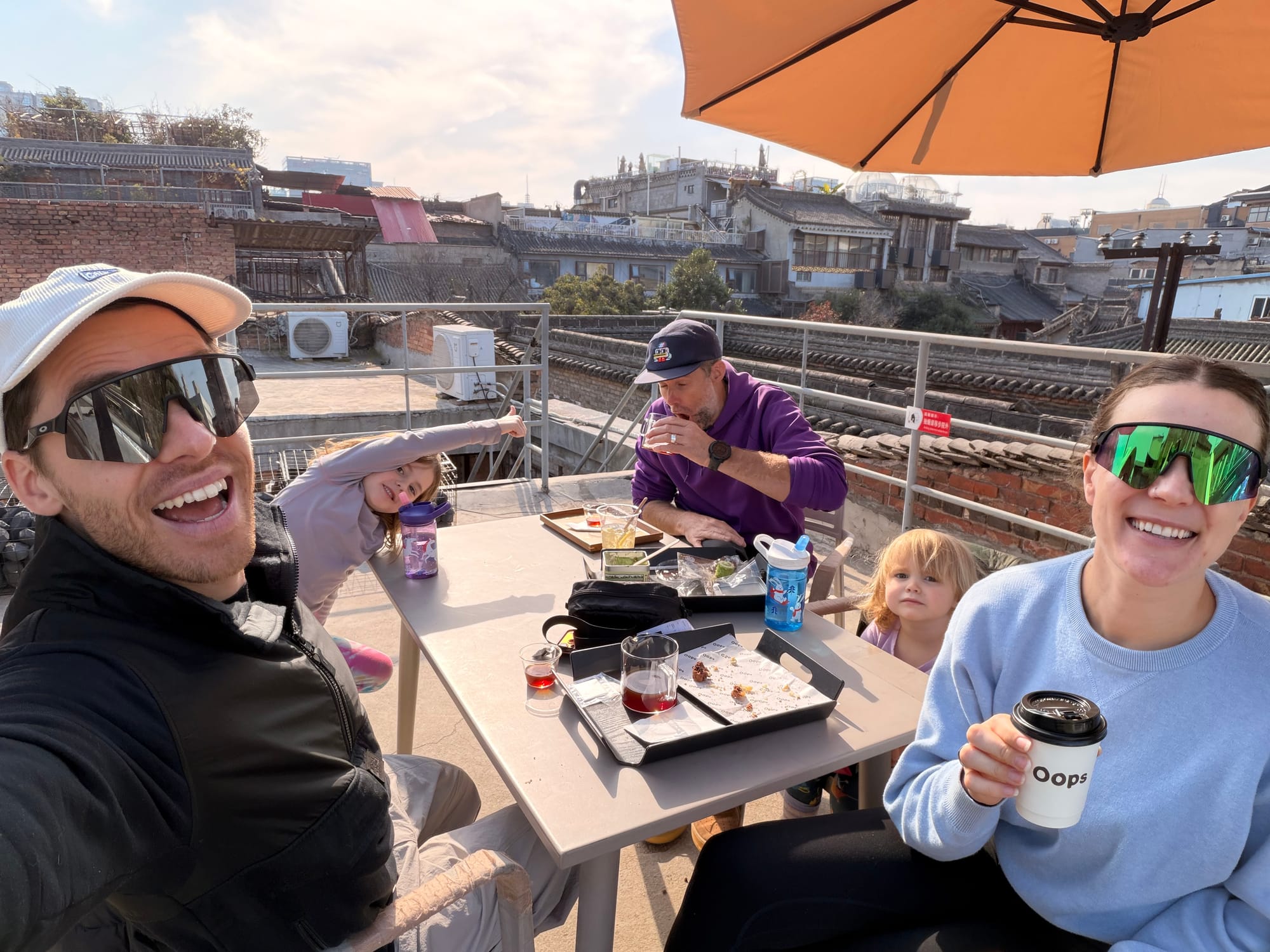
Then Yangshuo, which we expected to be a village and was, of course, a city with malls. We rented speed-capped electric scooters from the hotel for about $4 a day and did everything on them: dinners under Moon Hill at Lisa’s (good English, gives you gifts, saved us many times), a guided top-rope climbing day for ~$60 each with a guide who was essentially a Chinese climbing bum, and one golden-hour ride up the Ruyi Peak cableway an hour before close. In China everything touristy is insanely busy, but at 5pm we had a suspension bridge, a glass walkway, and the entire sunset to ourselves. Probably the best cableway of the trip.
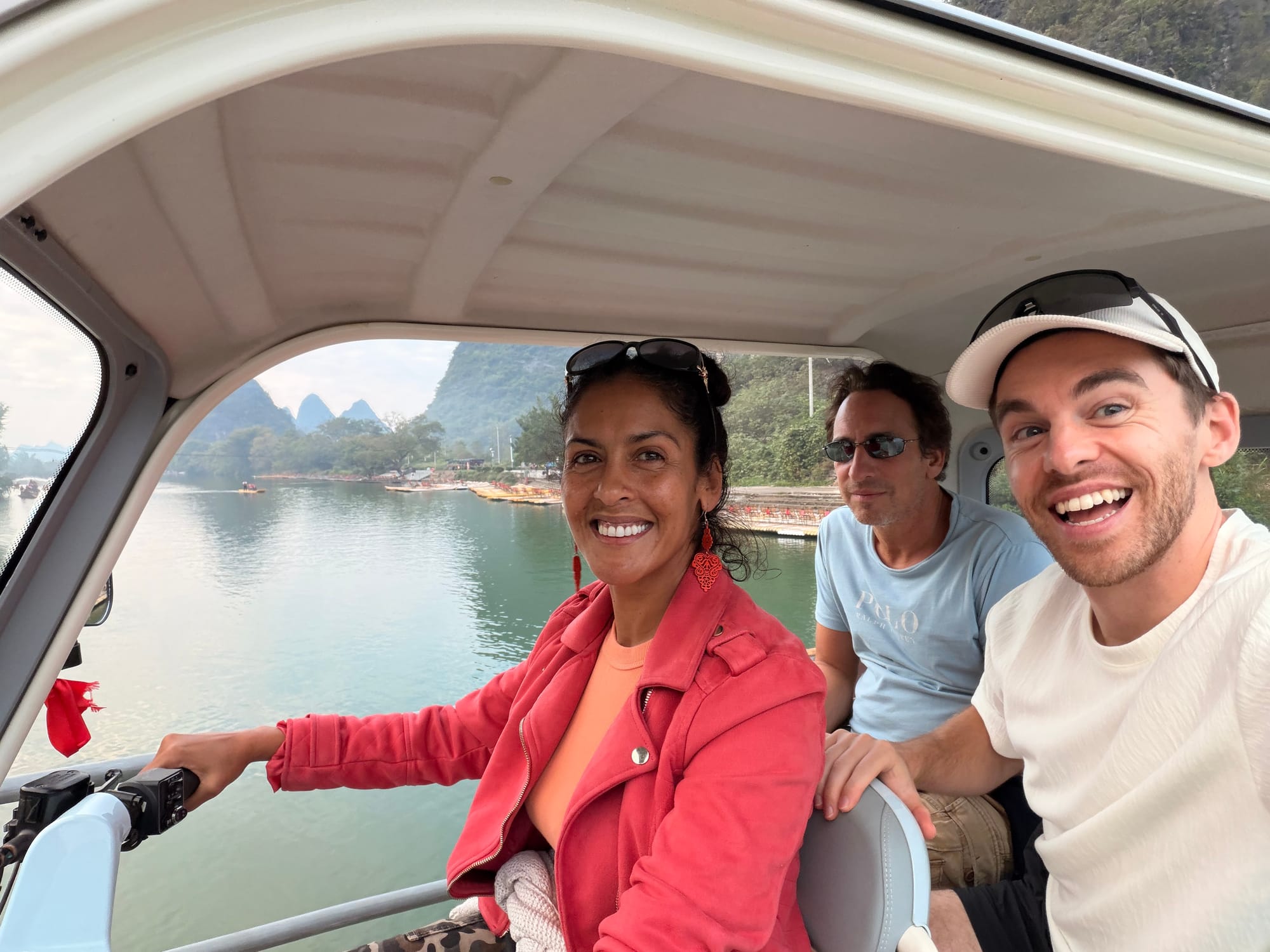
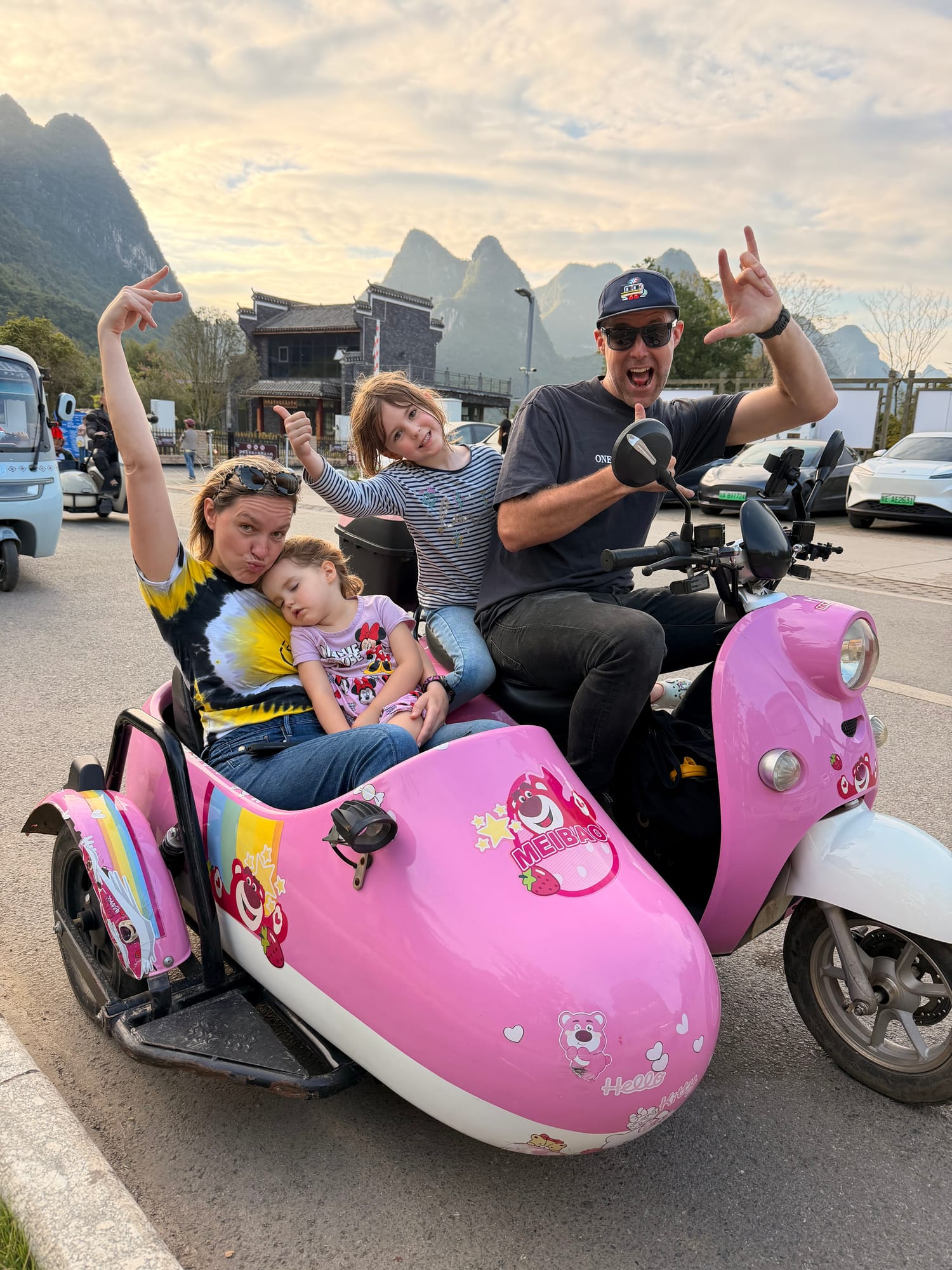
The day everyone still talks about was the dumbest one: we rented cutesy electric river buggies with Glen’s family (theirs was a pink four-seater with a sidecar) and drove north along the river as the sun set. Proper road, then concrete, then dirt, then a stretch of loose rock we gambled on, then a walking trail where roughly ten consecutive locals told us to turn around, all with the same message: there is no bridge back across the water. Every map we had agreed with them. No tourists, no cars, karst towers going gold. “It was adventure and it was with everyone and it was also super beautiful.”
Everybody said we couldn't. There was no bridge... And then when we got there, it was totally a bridge.
Leaving was the closest call of the month. The main highway out was closed, the ETA said we’d miss the Chongqing train, and our Didi driver looked at us, asked “is this okay?”, got a no, and drove like a rally driver for 40 minutes, overtaking into oncoming traffic that didn’t even honk. We made it with one or two minutes to spare. The kicker: all that driving beat the app’s original ETA by about a minute. Didi simply knows.
Chapter 02 / 08Day 6 of 31 · 5,500 km to go
Chongqing
03 · Thirty million people, stacked vertically

Thirty million people, an 18,000-drone show, a train through a building. Two days is right.
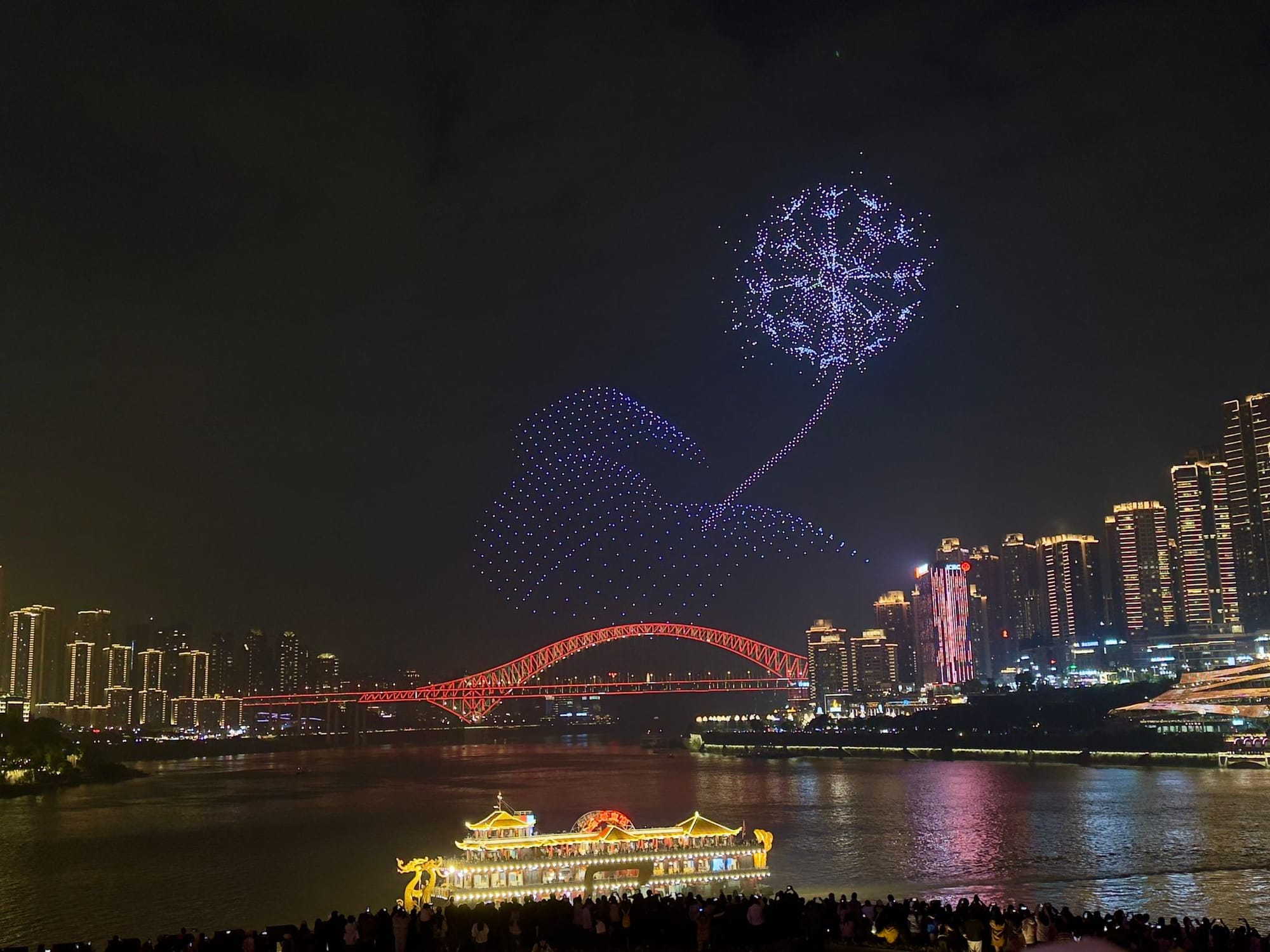
We arrived starving. Nobody had eaten all day (the train’s food was either mega-spicy or bad, so Esme and James dined on a packet of Pringles and a packet of Oreos each), and we went straight from the platform to a second Didi to a sprint along the waterfront, because Chongqing’s drone show only happens on Saturday nights. We made it. Sixteen to eighteen thousand drones swarming into shapes over the river. “The highlight was definitely the unicorn.”
Chongqing is 20 to 30 million people built on cliffs, and it photographs like a video game. We stayed in a high-floor penthouse-style room for about $70 a night, which is the going rate here for 70 square meters and a wall of glass. First lesson: there is no such thing as a non-smoking room in Chongqing. We smelled the first room, complained, and ended up with a better penthouse two nights later.
It's just a scale of how smoky it is.
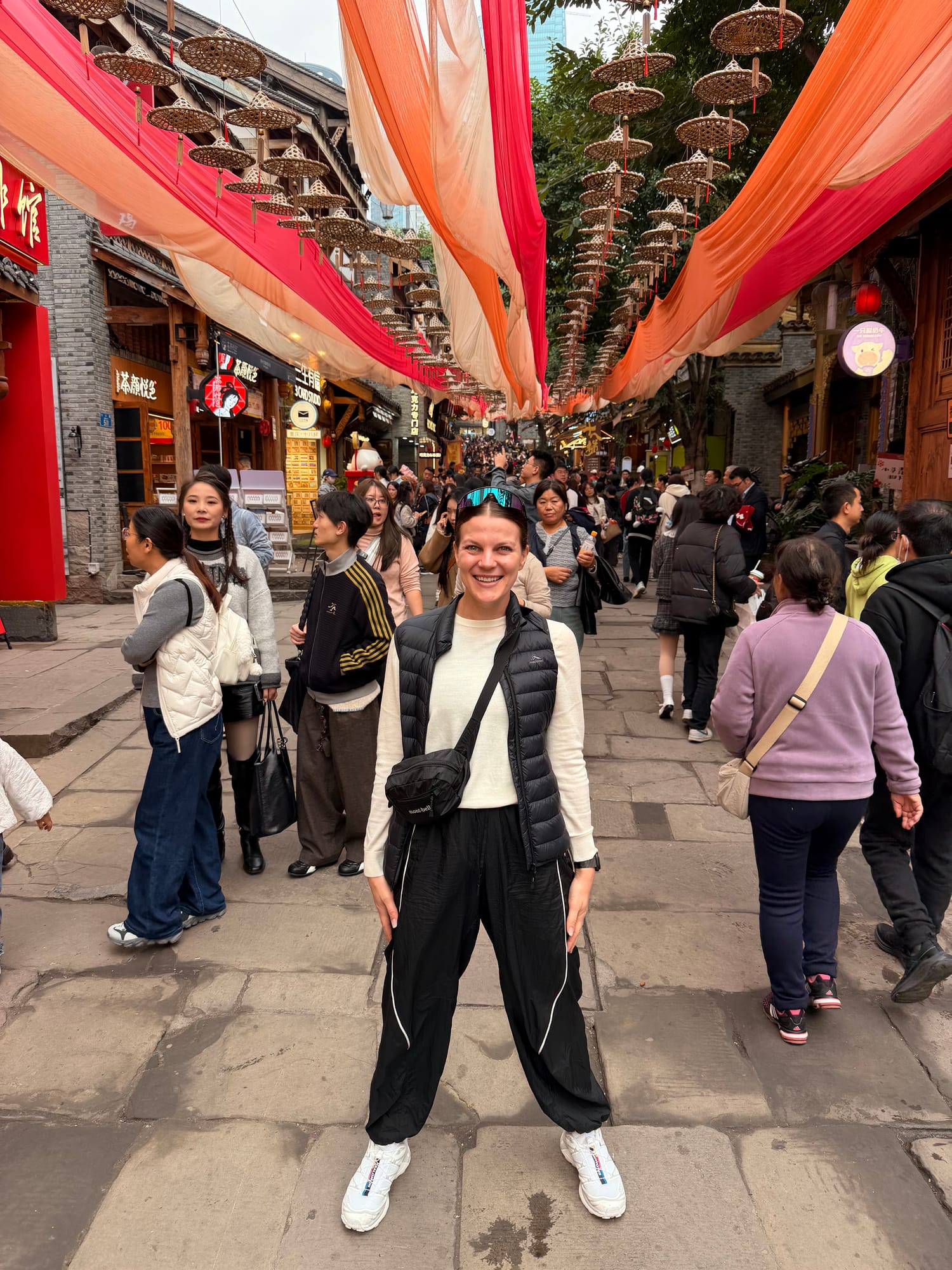
The famous stuff is famous for a reason. We rode the metro to see the train that passes through an apartment building at Liziba, and realized mid-ride that we were ON the train going through the building, with hundreds of people below photographing us. The viewing platform exits through five levels of gift shop. At street level in Shibati old town, Glen and James got their ears cleaned on camera while crowds FaceTimed their relatives to show them Glen’s blonde three-year-old. In China, a white toddler is a national attraction.
My favorite hours were quieter: a steep 15-minute walk up to the hilltop tea houses above the city, where a tea set is mandatory (~$12 a head) and comes with chestnuts, sweet potato, and mandarins to grill over coals while the sun goes down. A wandering lady delivered pizza up the hill from a menu that mysteriously belonged to every tea house at once. China produces 75 percent of the world’s mandarins, a fact I learned while grilling one.
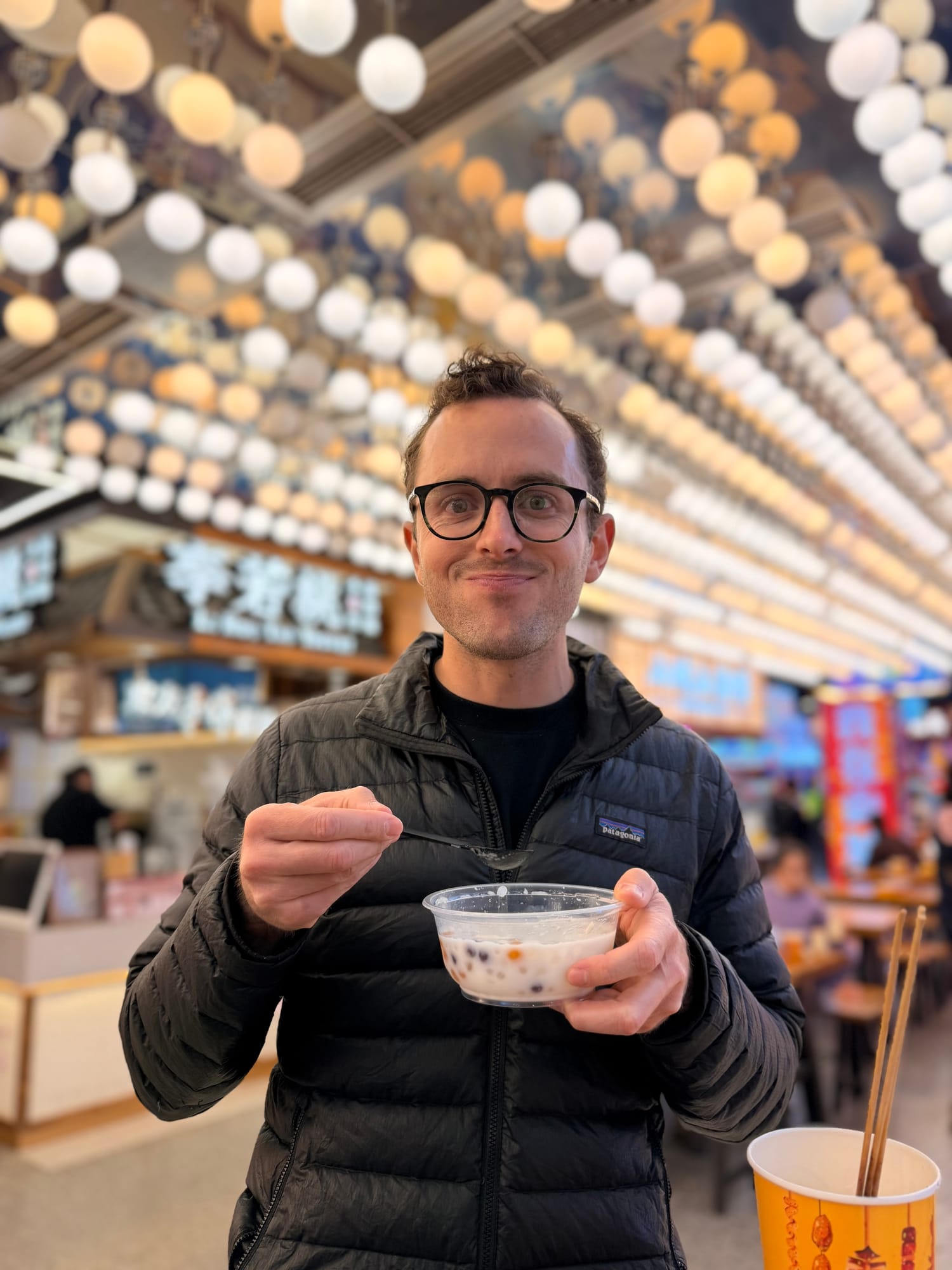
Also filed under China-scale: Chongqing East station, three months old, roughly $2 billion, and almost completely empty. “Someone got paid handsomely for creating this ginormous thing and it boosted their GDP.” We left from it anyway, on a brand-new line toward the Avatar Mountains.
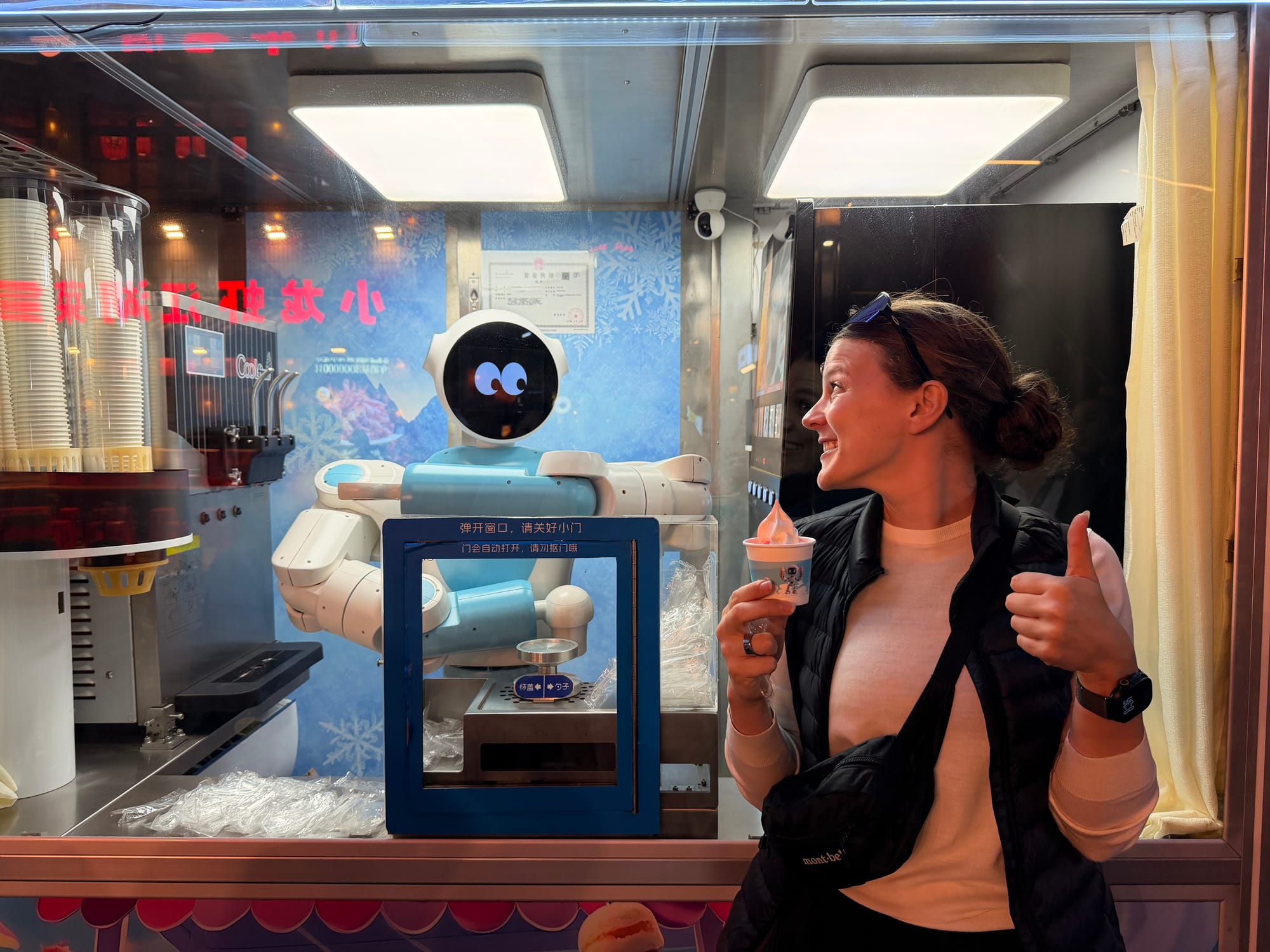
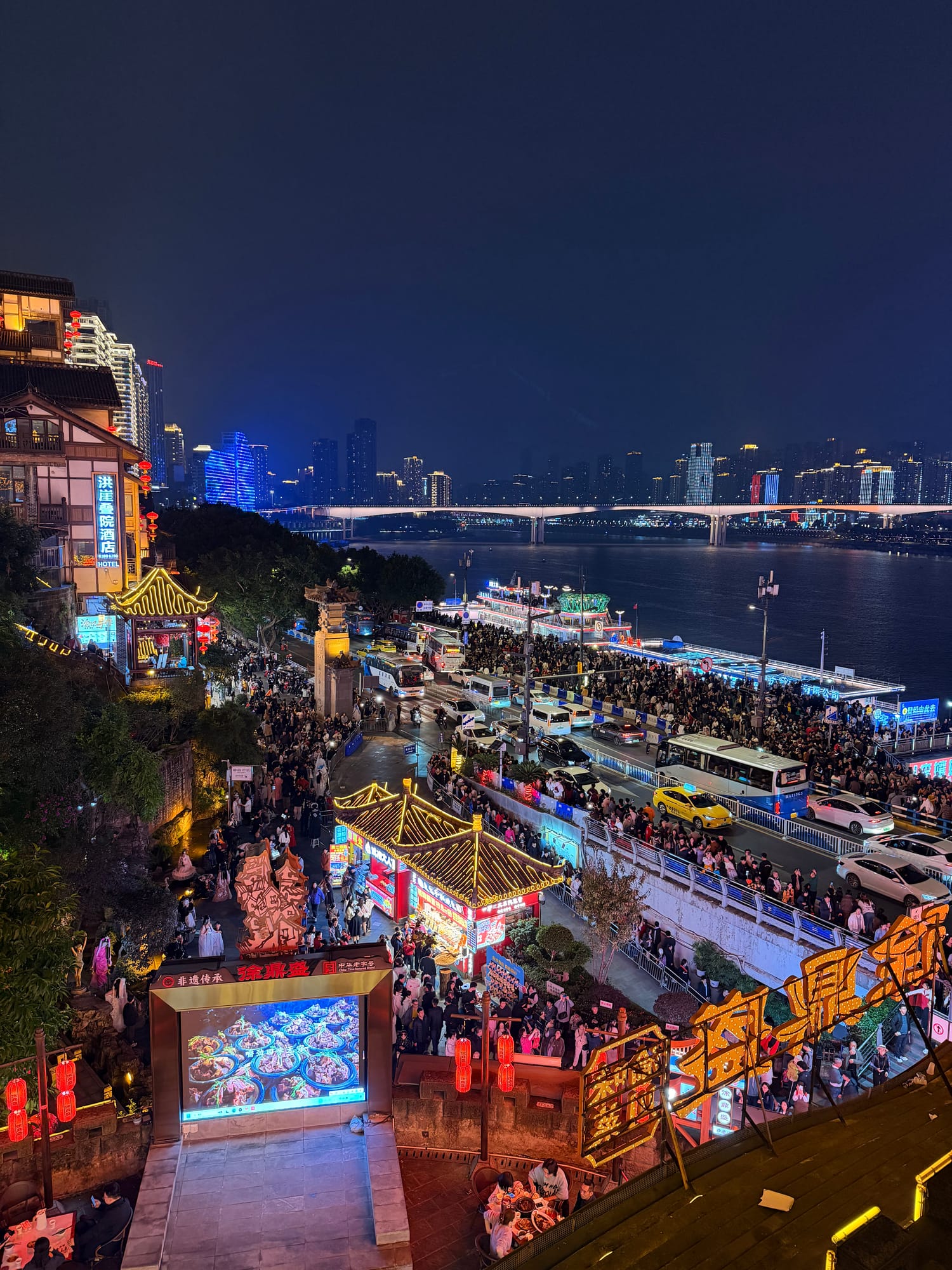
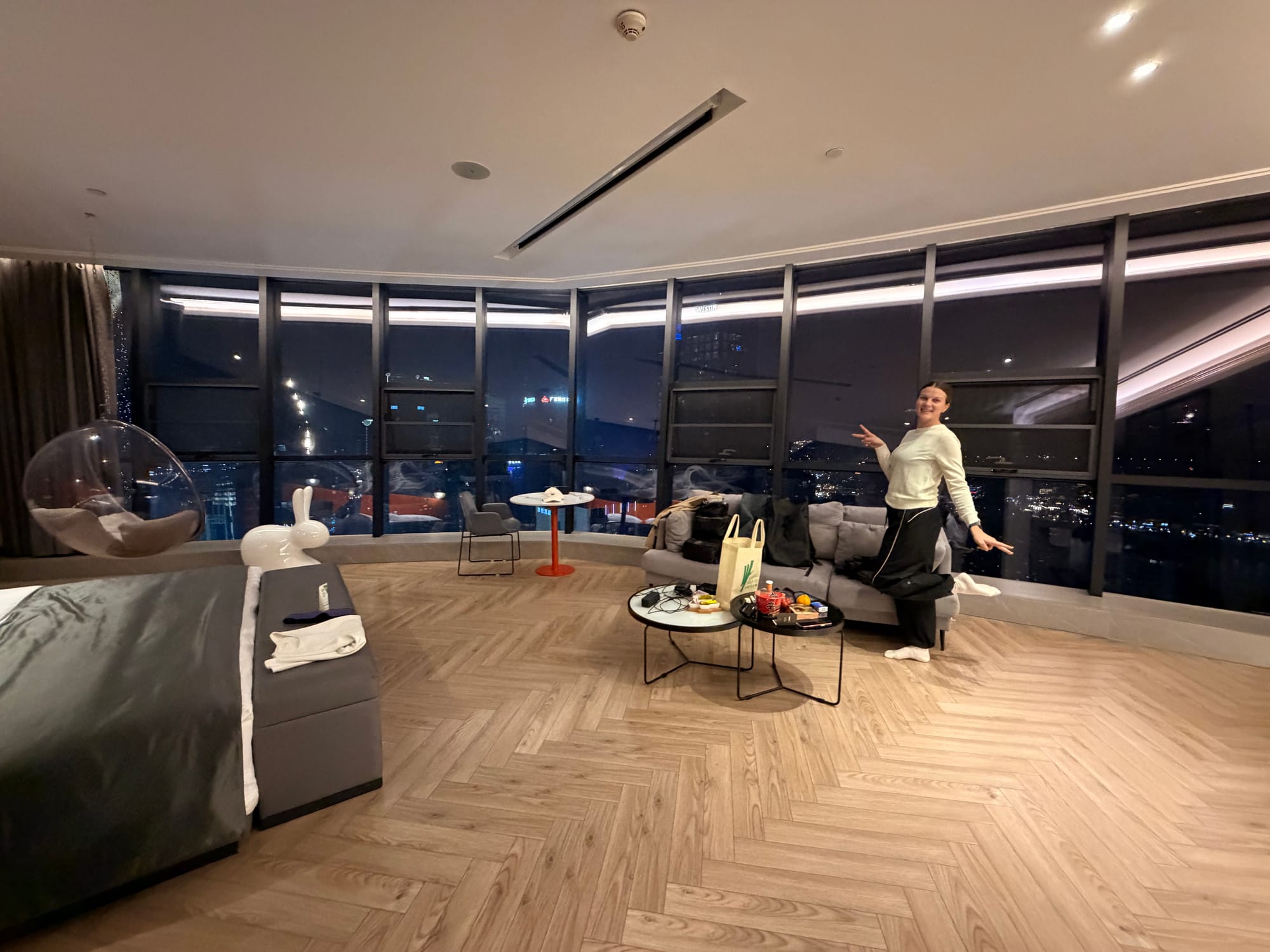
Chapter 03 / 08Day 8 of 31 · 4,900 km to go
The Avatar Mountains
04 · Crowd-hacking Zhangjiajie

At the gates by 6:50am, the Avatar Mountains are yours until 10:30.
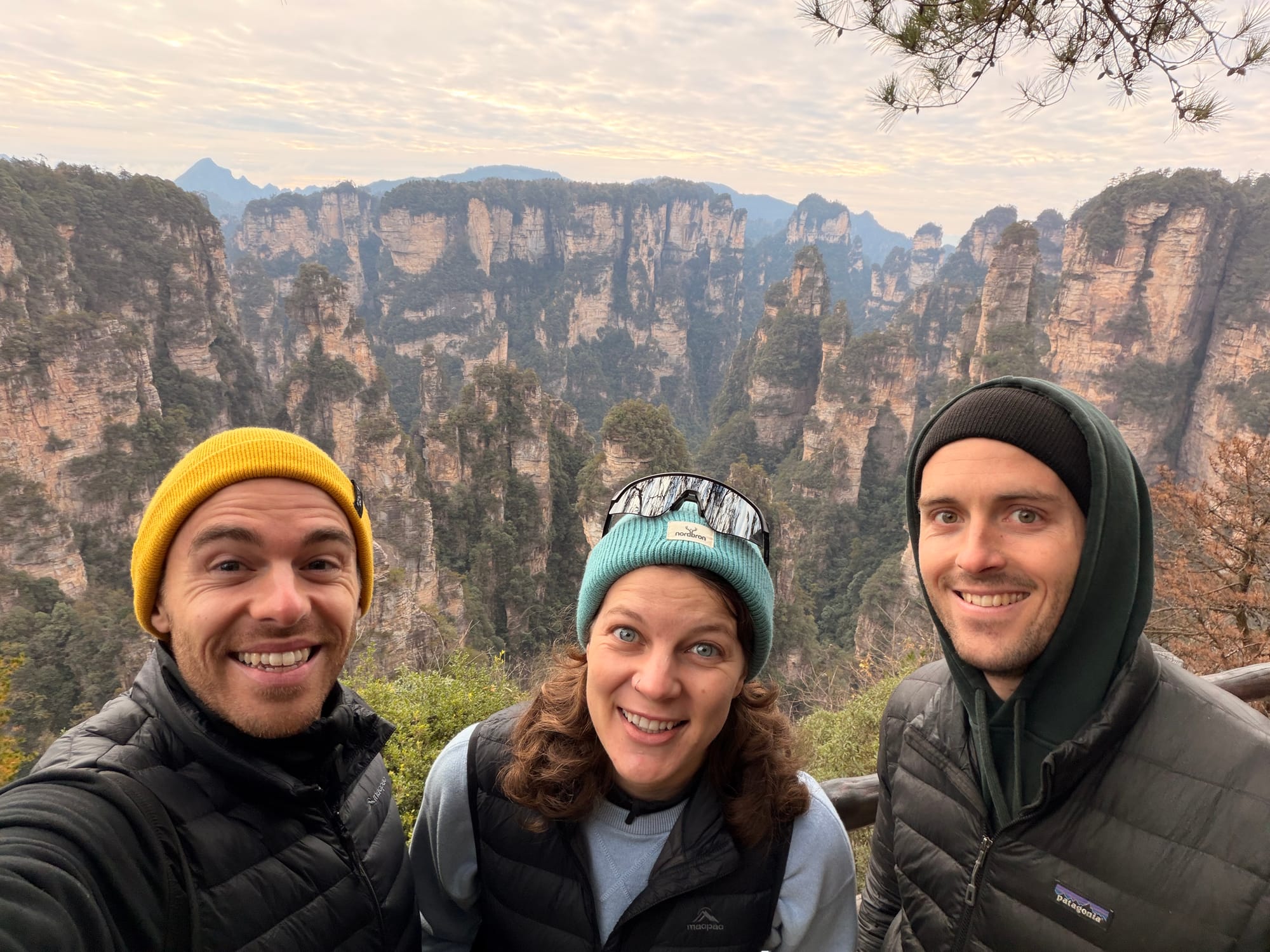
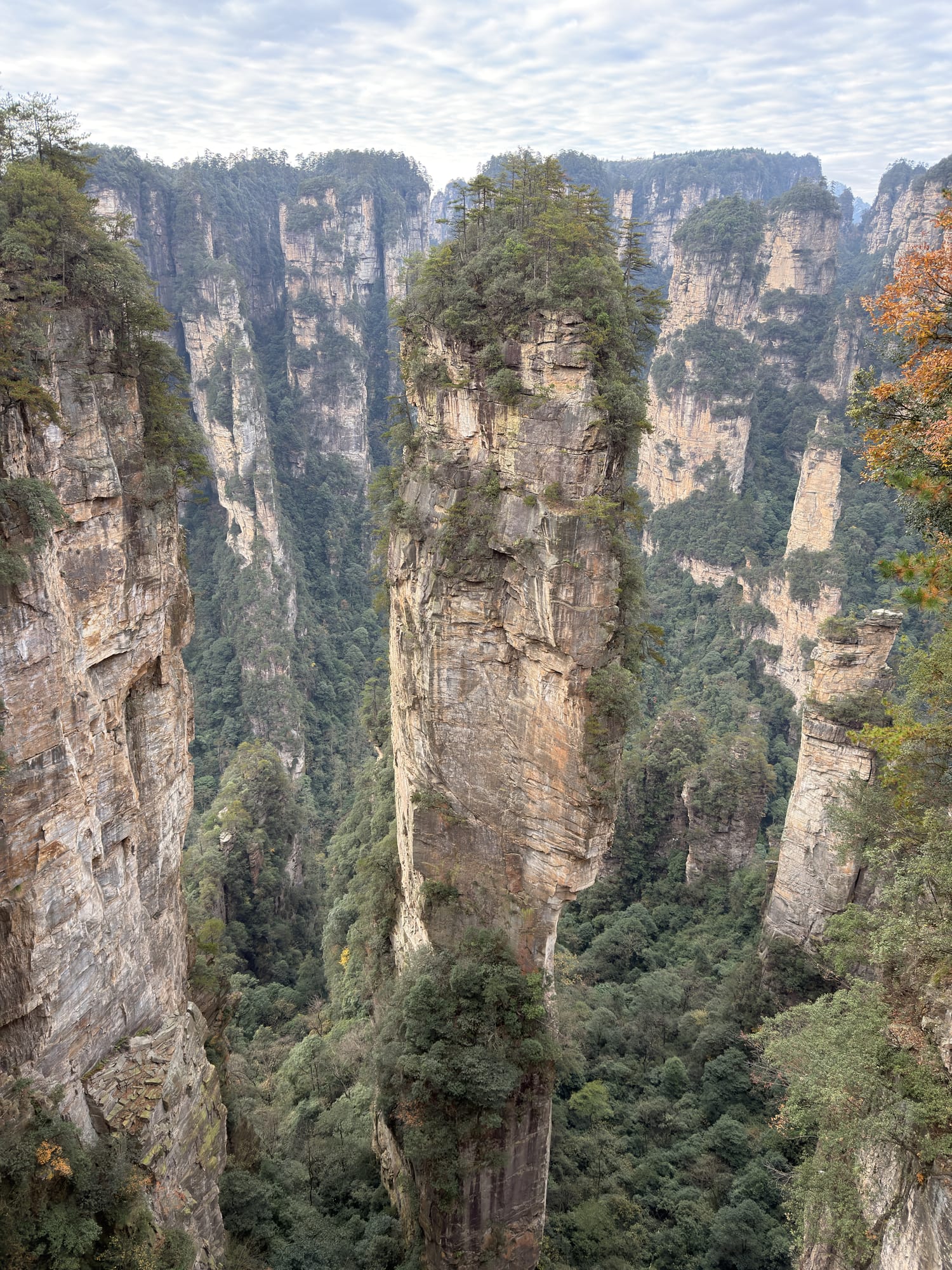
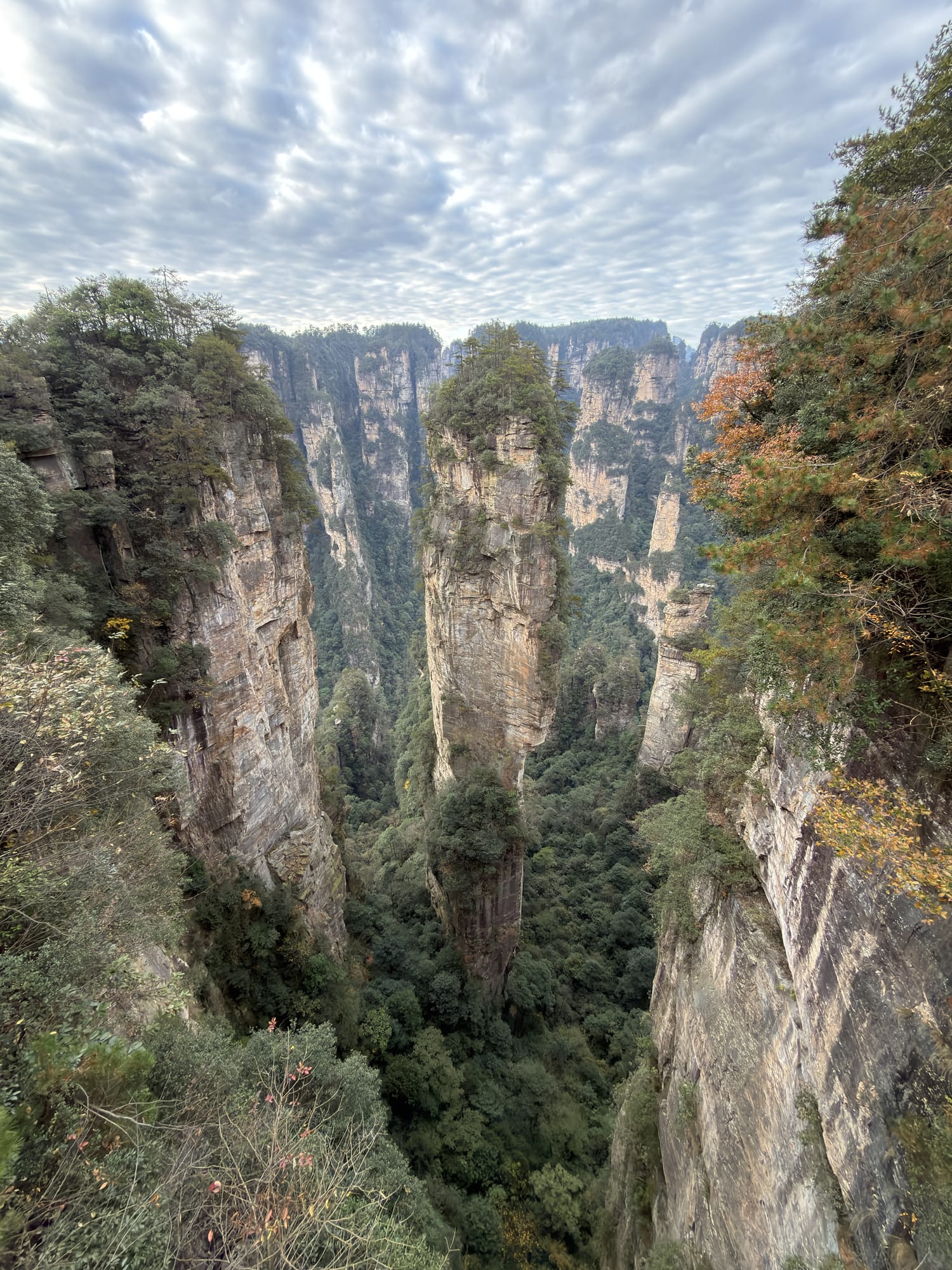
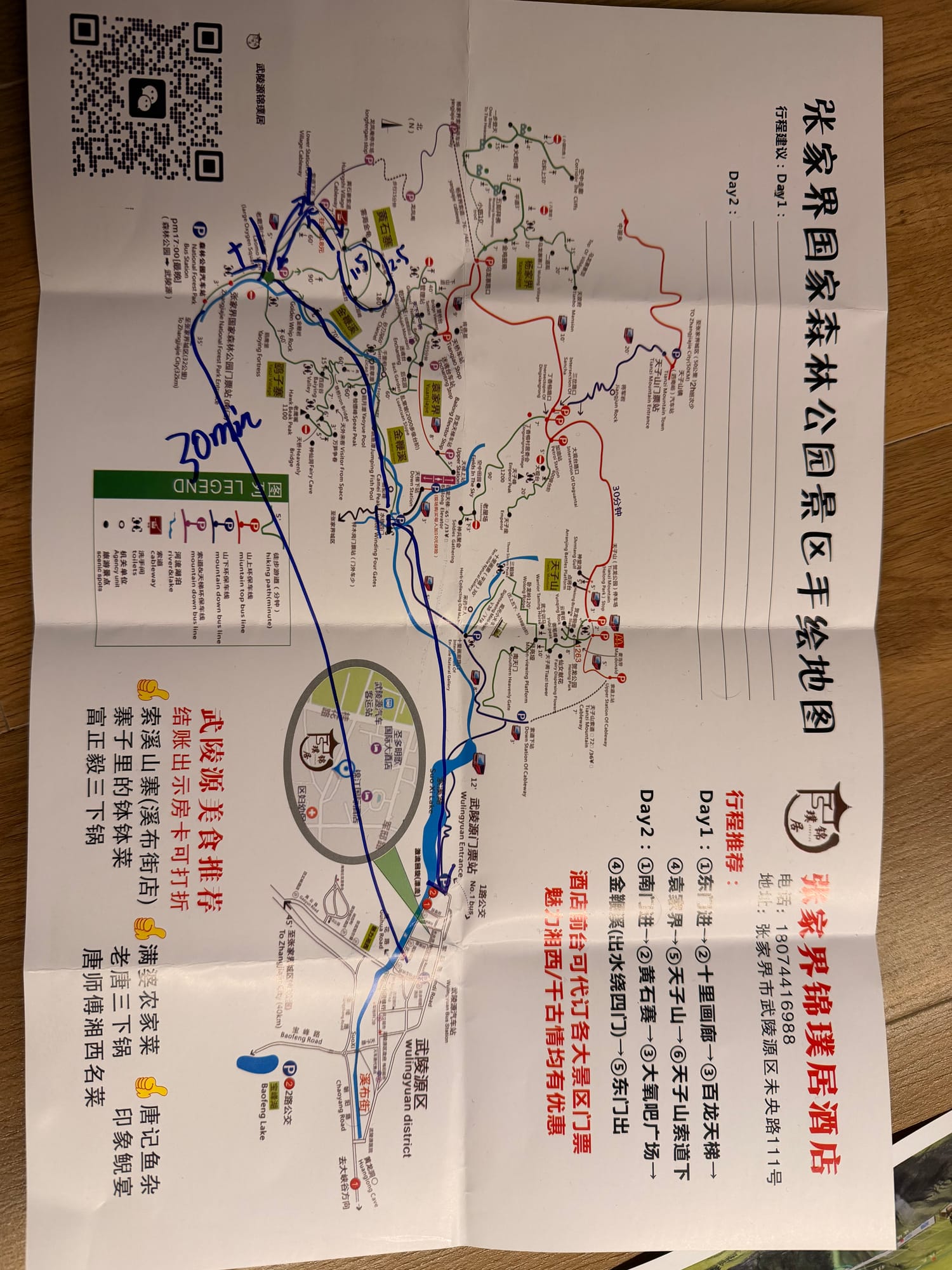
Zhangjiajie National Forest Park is the landscape James Cameron borrowed for Avatar, and it absorbs tens of thousands of visitors a day. The playbook that beat it: sleep in Wulingyuan, the gate town 40 minutes from the city, and be at the gates by 6:50am wearing every item of clothing you own. Our homestay host briefed us on routes through a dedicated translation device, the only one we saw all month, “transmitting all of the information from her brain into ours.” She knew exactly why we’d come. Everyone comes for the same mountains.
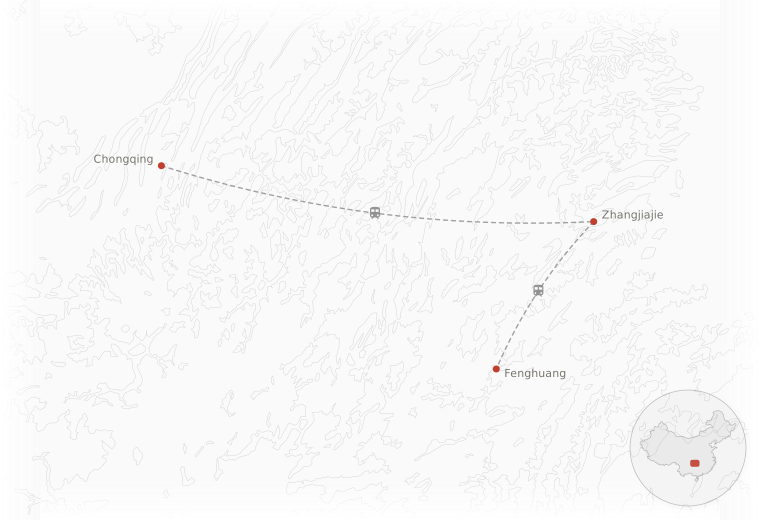
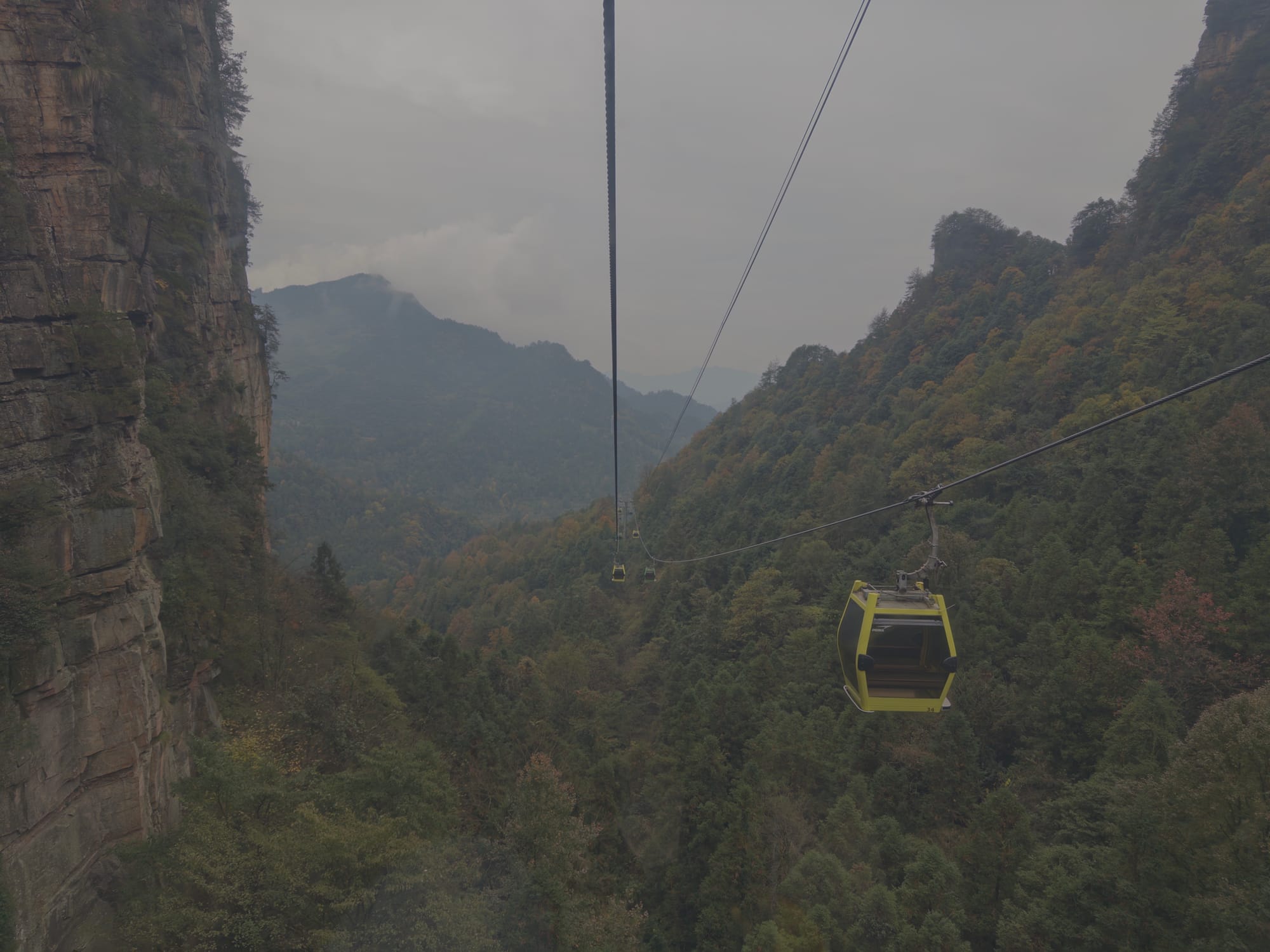
It works because of the one fact that beat every crowd in China, applied here at its purest. First bus in, first at every viewpoint, monkeys for company. The Bailong elevator is skippable (you see the view for about five seconds), but the final gondola down is genuinely epic. Up top there’s a McDonald’s and a Luckin, the only warm rooms on the mountain. I had a McDonald’s coffee, I’m not scared to admit. By 10:30 the tour groups arrived, photographing statues of famous communists with their backs to the cliffs, and we were already done.
Chinese people do not wake up early.
Day two was better. Sunshine, the quieter west gate, 8am passes, and the impulse decision that made the whole leg: instead of sampling 20 minutes of the Golden Whip Stream, we walked all 10 km of it in the midday sun, looking up at the towers from the gorge floor. “You realize just how tall they are.” On the way out, an English-speaking tour guide told her group “there is basically no one here” while six tour groups milled around us. During holidays, hundreds of groups with distorted loudspeakers pack that courtyard. November weekdays are the move.
Wulingyuan also delivered the trip’s first $7 dinner for three people: dumplings, noodle soup, fried rice, peanut-butter dumplings, from a couple running a tiny spot James found. Our host had warned us “around here there’s only local food, nothing’s good.” She was wrong by a wide margin.
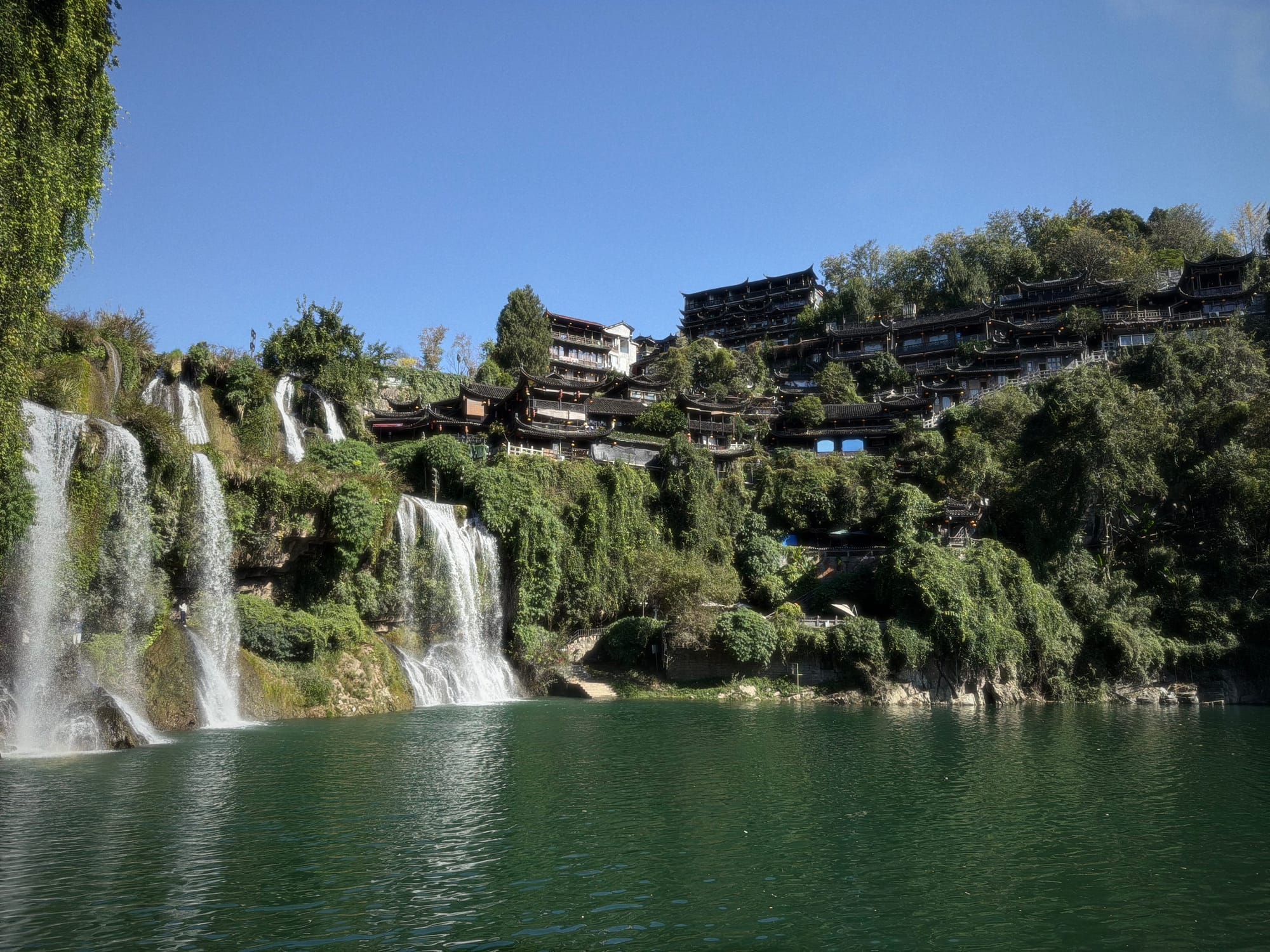
We finished the leg with a night in Fenghuang, the riverside ancient town, everything lit up, plus a two-hour stop in Furong, an old town built over a waterfall. Furong charges entry, which keeps it eerily, wonderfully quiet: “definitely the most stunning old town. One of the best places in China.” Fenghuang, meanwhile, gave us the only digestive incident of the entire month, a synchronized emergency shuffle home that ended at a dead hotel key card. One and done, both of us. China’s food hygiene was otherwise flawless for 31 days.
Chapter 04 / 08Day 11 of 31 · 4,500 km to go
Xi’an & Huashan
05 · The surprise best mountain in China

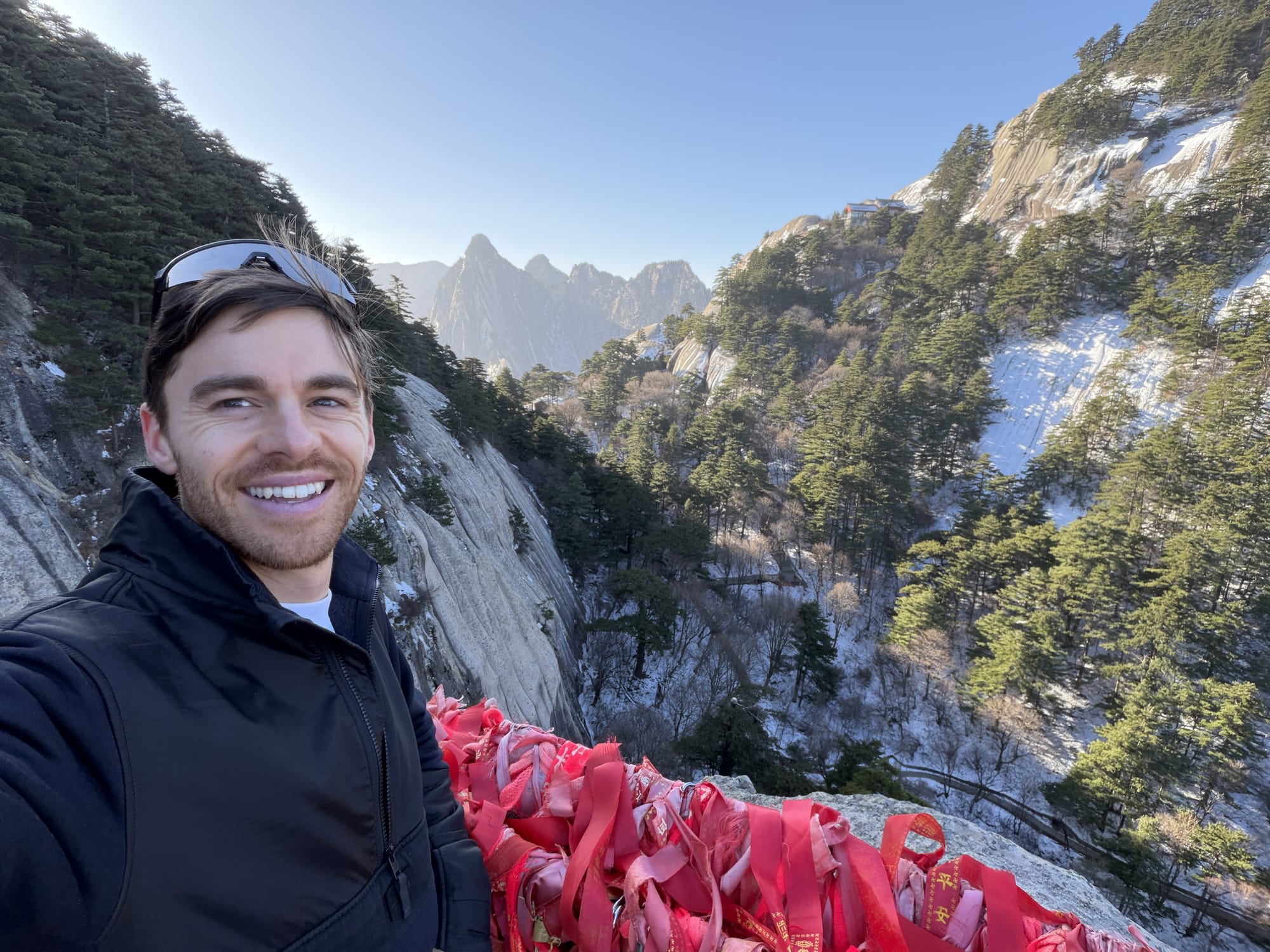
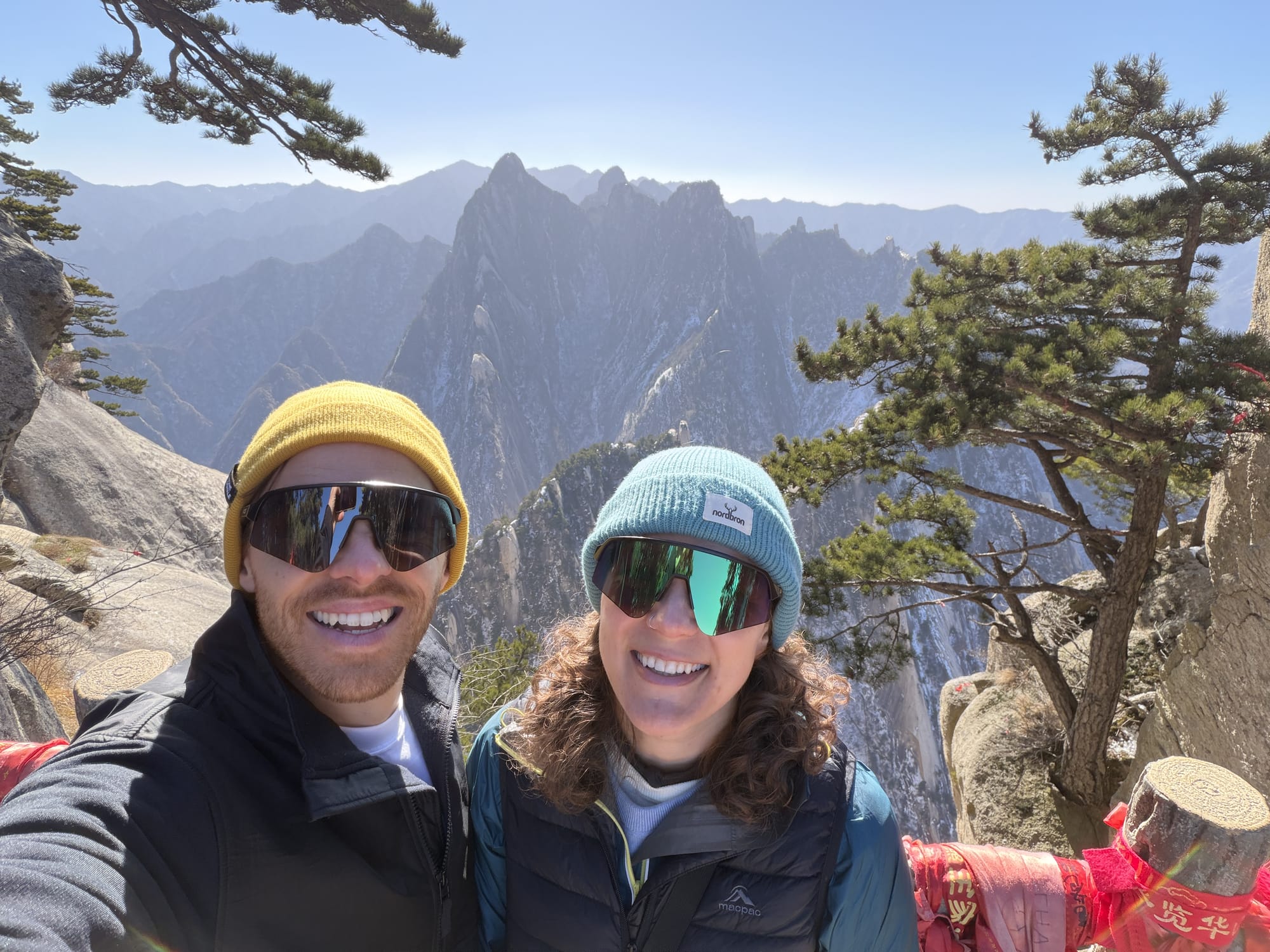
Huashan was the best mountain of the trip. The Warriors are a half day.
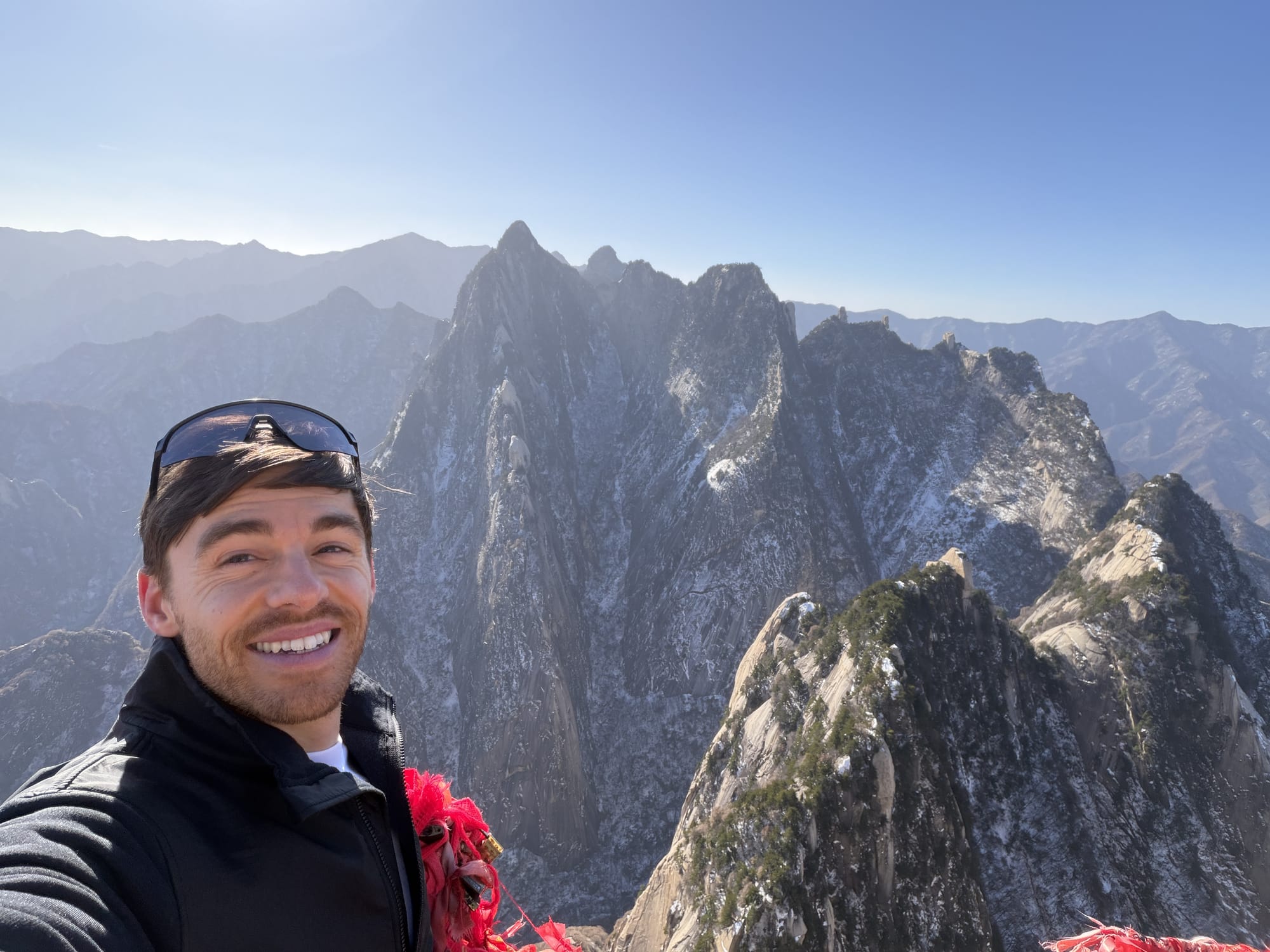
We came to Xi’an for the Terracotta Warriors. The actual reason to come is Huashan.
The plan was to sleep in Xi’an and do the sacred mountain as a day trip. Mid-flight from Zhangjiajie we ran the numbers, landed, cancelled the city hotel from an airport Starbucks (the first time we clocked that Starbucks would be our haven in China), and Didi’d out to a $16 homestay at the foot of the mountain instead. The lady picked us up from the station at midnight, sold us snacks, helped buy tickets, and delivered the crucial intel: the main gondola was closed for maintenance tomorrow. Translation: everyone funnels onto one gondola, and the normal way up becomes a real hike. For us that was the feature.
She drove us to the gate at 7am. Thousands of stairs, two-plus hours of climbing, all four peaks, narrow ridges with nobody on them, little old temple buildings scattered up high. Crisp, cold, blue-sky perfect. Social media calls Huashan the most dangerous mountain in the world; the famous plank walk is actually pretty easy, and we skipped it anyway because foreigners get admitted at set times with a multi-hour wait. Coming down at midday we passed the single-file masses coming up. The homestay lady met us at the bottom with our bags already in the car. Sixteen dollars.
You're just discovering this place but all on your own. And usually this mountain is just packed all the time.
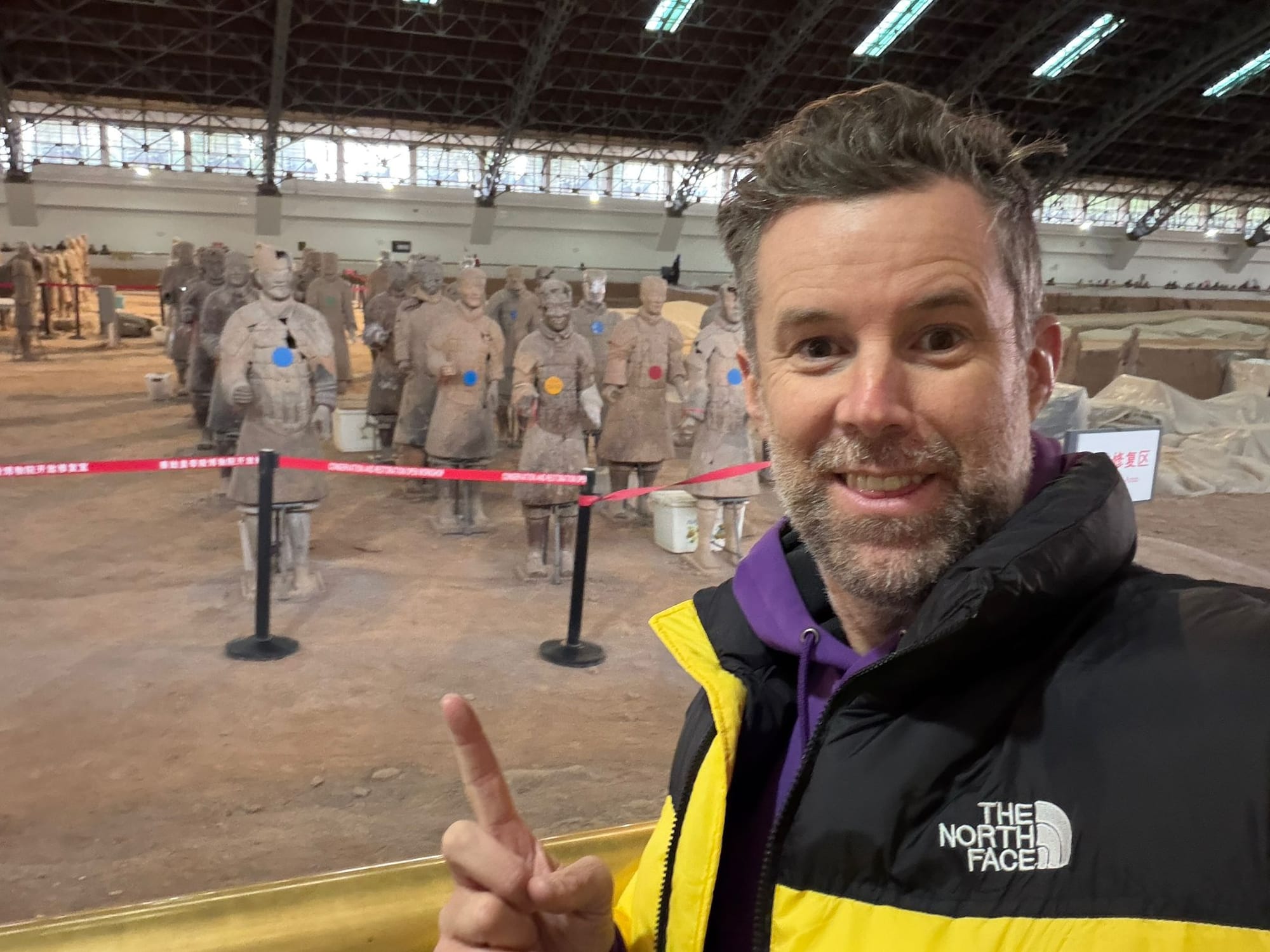
The Warriors the next morning ran the same playbook: at opening, straight to the biggest pit, clear views for an hour, packed by the time we circled back. The reframing fact: a farmer found this digging a well in 1974. Anyone who toured China before then simply never saw it, and the emperor’s full underground city, reportedly Manhattan-sized, is still unexcavated. “We’re just seeing the army.”
Xi’an itself earned two more days. A local fake market (five floors, posted prices, zero hustle, vendors who treated white guys as mildly a hassle rather than prey) sold us the winter jackets that saved the Beijing leg, $20-25 each; I collected photos of every misspelled North Face variant in the building. And on the last night we watched two rotating-audience mega-theater shows back to back: hundreds of seats turning in sync, a plane crashing into an on-stage pool, live camels, live dogs, and a finale where all nations bow down to Xi’an. “It was the New York of the time. And China still thinks it’s the New York in a way.” Hilarious propaganda, spectacular engineering, quarter-full venue.
Chapter 05 / 08Day 15 of 31 · 3,800 km to go
Beijing & the Great Wall
06 · Sunrise and sunset on the wall

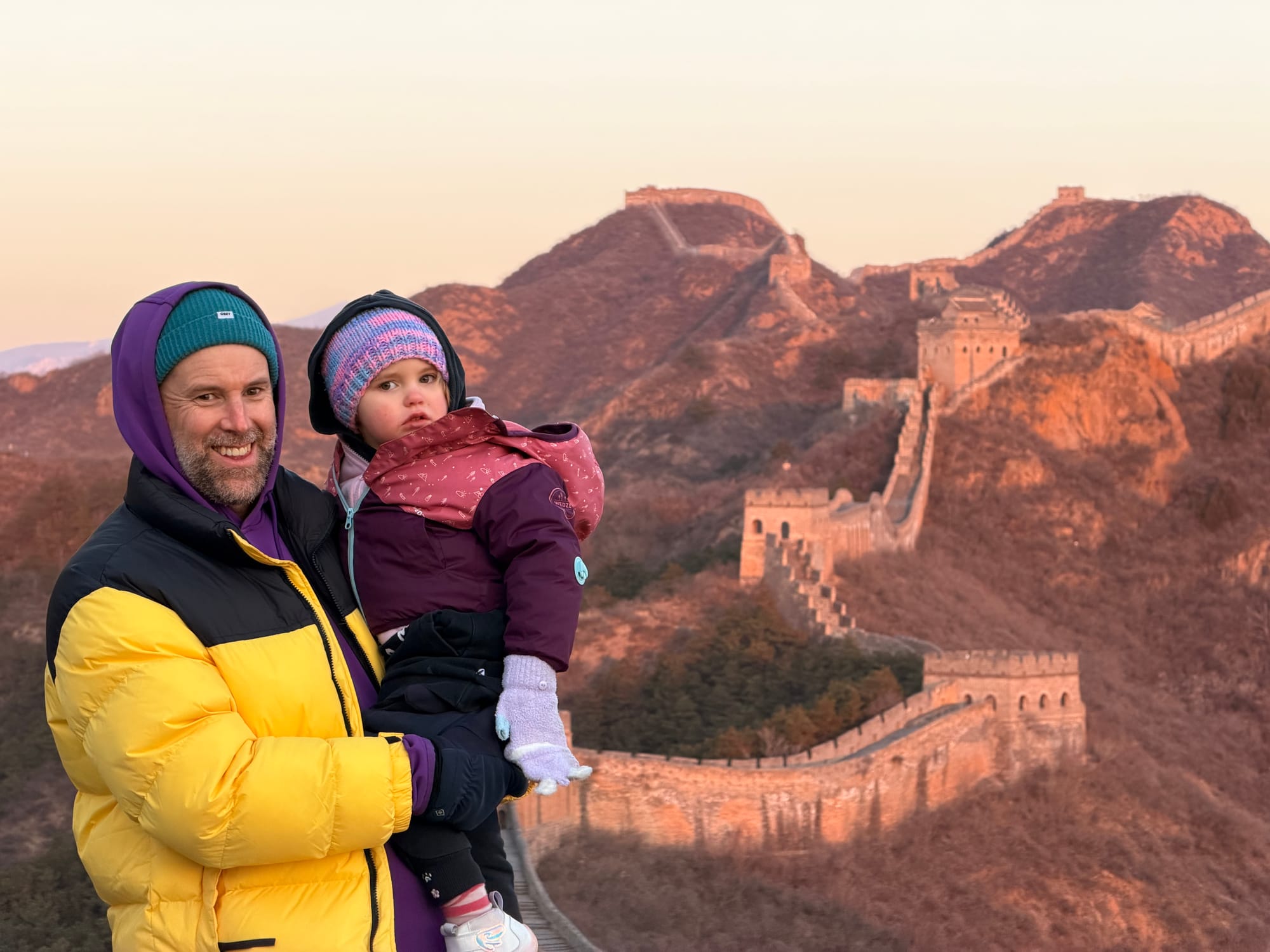
Jinshanling is the whole reason to come: sunrise and sunset on the wall in one day.
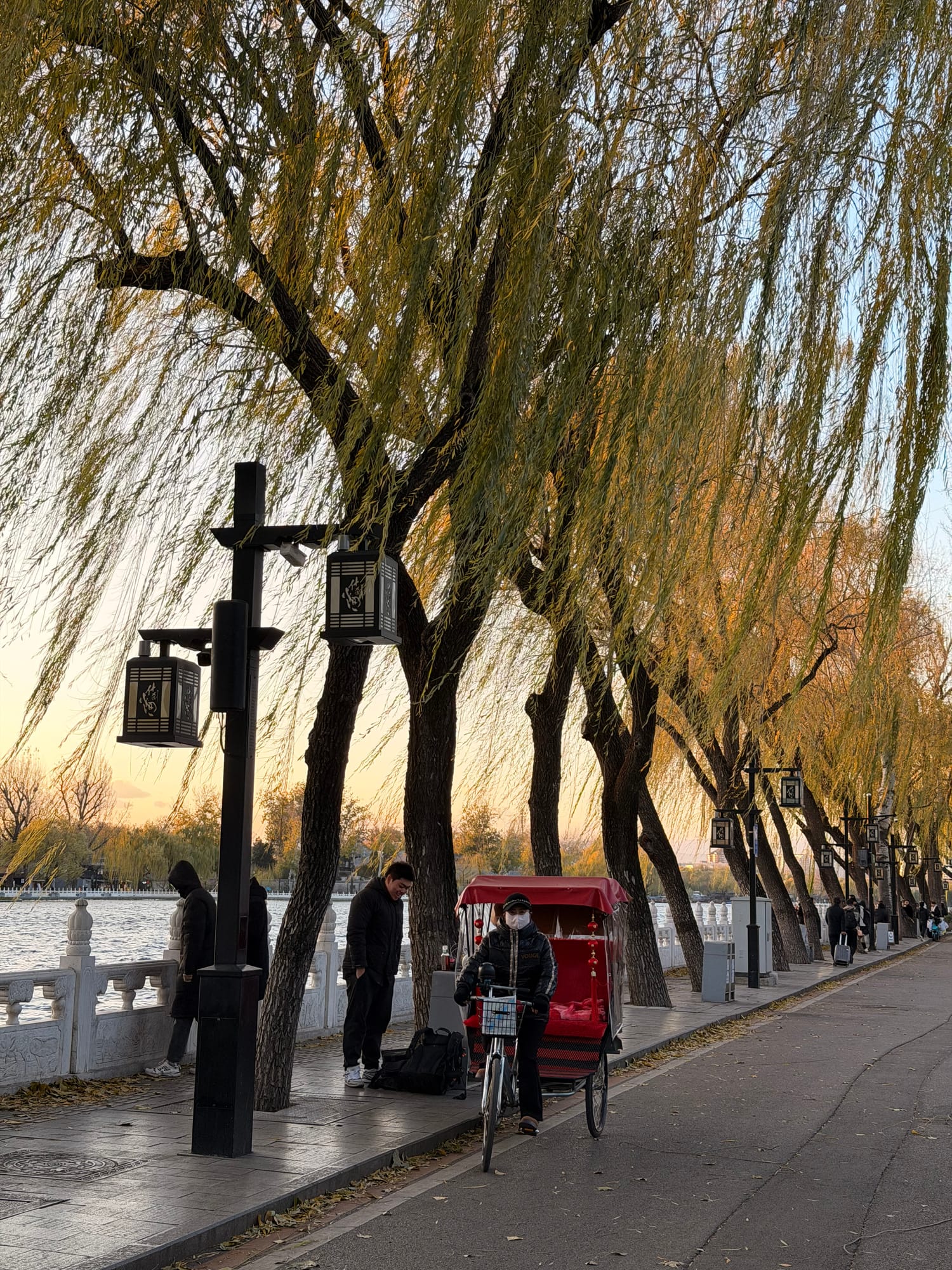
Beijing surprised us by being lovely and quiet. We stayed by the Houhai lakes just north of the Forbidden City, old courtyard buildings turned into cafes, and walked the lake at sunset in our fake-market jackets, which earned their $25 on day one of the cold spell. A stall with a long local queue sold us Chinese beef pies, because a queue at a food stall is the menu. Dianping (China’s Yelp, which Esme had finally cracked) then steered us into an accidentally regal Shanghainese restaurant where six staff watched two diners eat. Awkward and delicious.
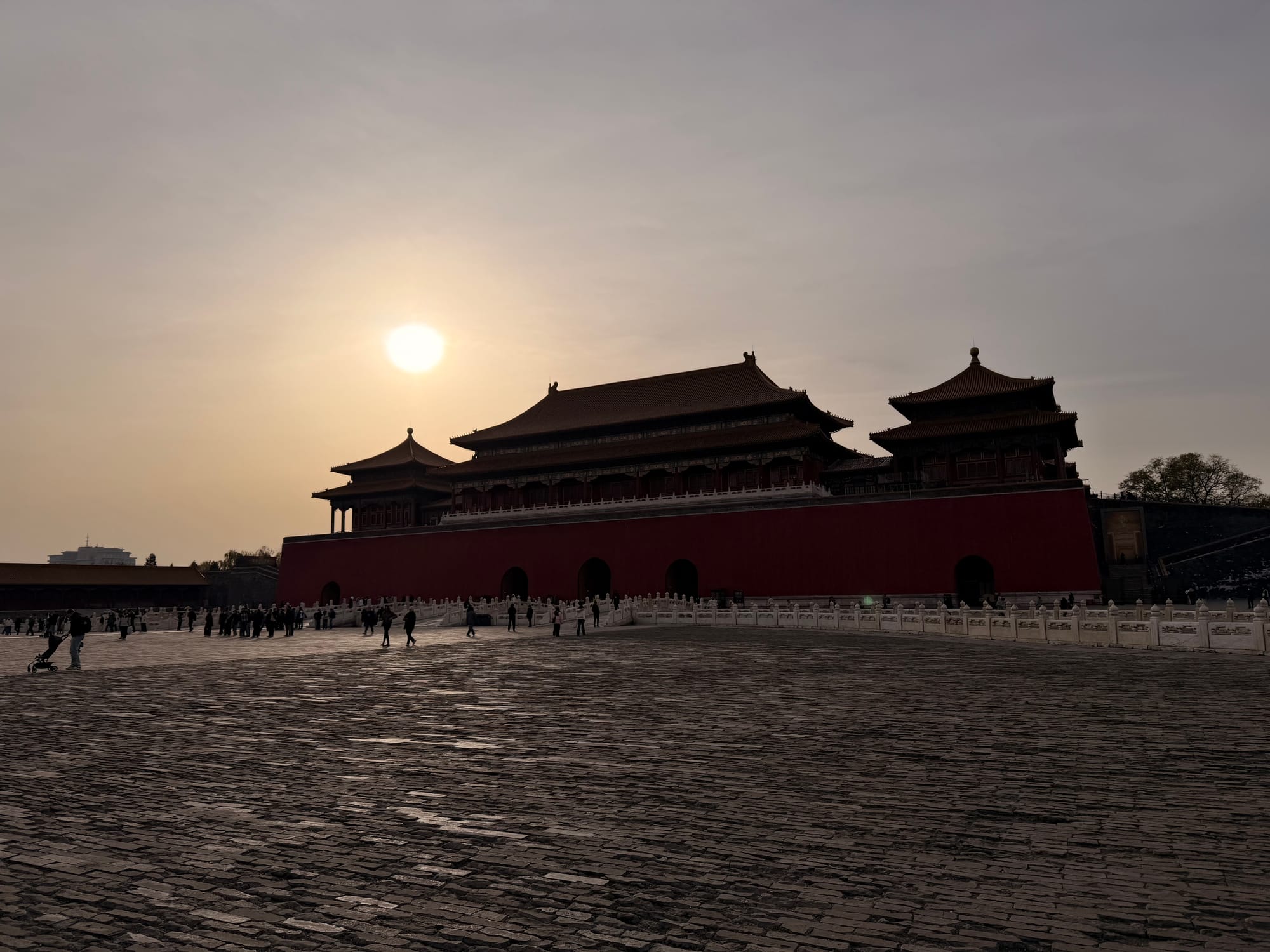
The big-ticket sights were fine. The Forbidden City is a 2 km walk before you even reach the real entrance; we did it south to north at opening with ChatGPT as tour guide and climbed Jingshan for the view back. Tiananmen Square needs a separate ticket booked the day before, which we didn’t have. The famous Peking duck came in a private room we unlocked by paying a 10 percent surcharge instead of waiting an hour: “of course we were willing to pay that.” Some of the best food of the whole trip, interrupted only by a waitress summoning us to watch a mediocre face-changing dancer.
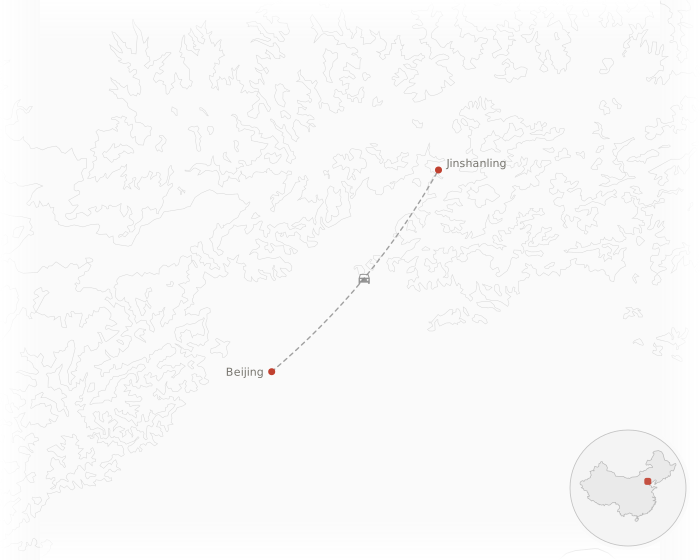
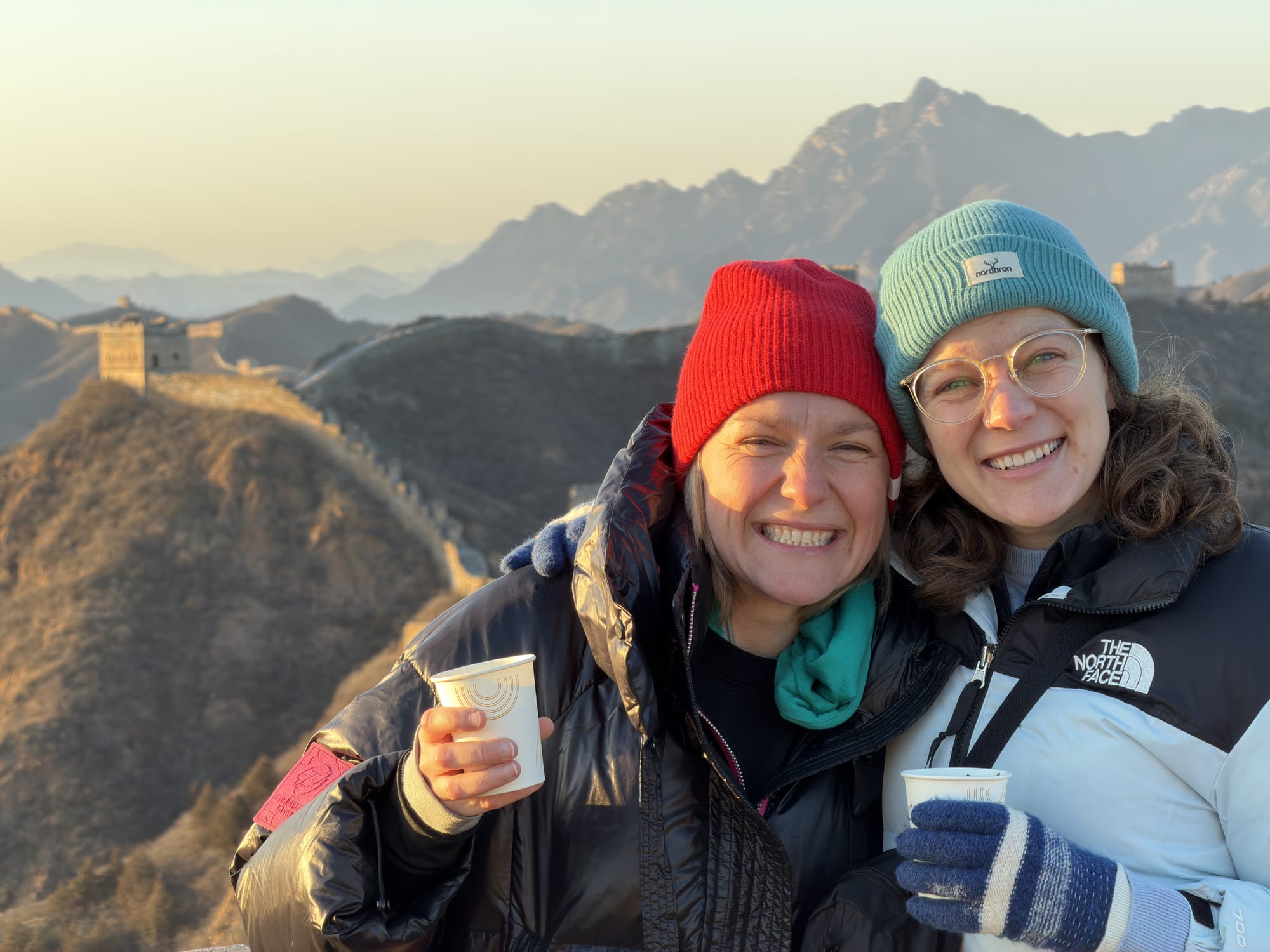
Then we left Beijing, and the trip peaked. Glen had organized a private van 2.5 hours north to Jinshanling, the section of wall photographers pick: aggressive sharp zigzags, well preserved, and far enough from the city that nobody’s there. The homestay host in the tiny village spoke the best English we met all month, cooked some of our favorite food in all of China with his wife, and booked our sunrise taxi.
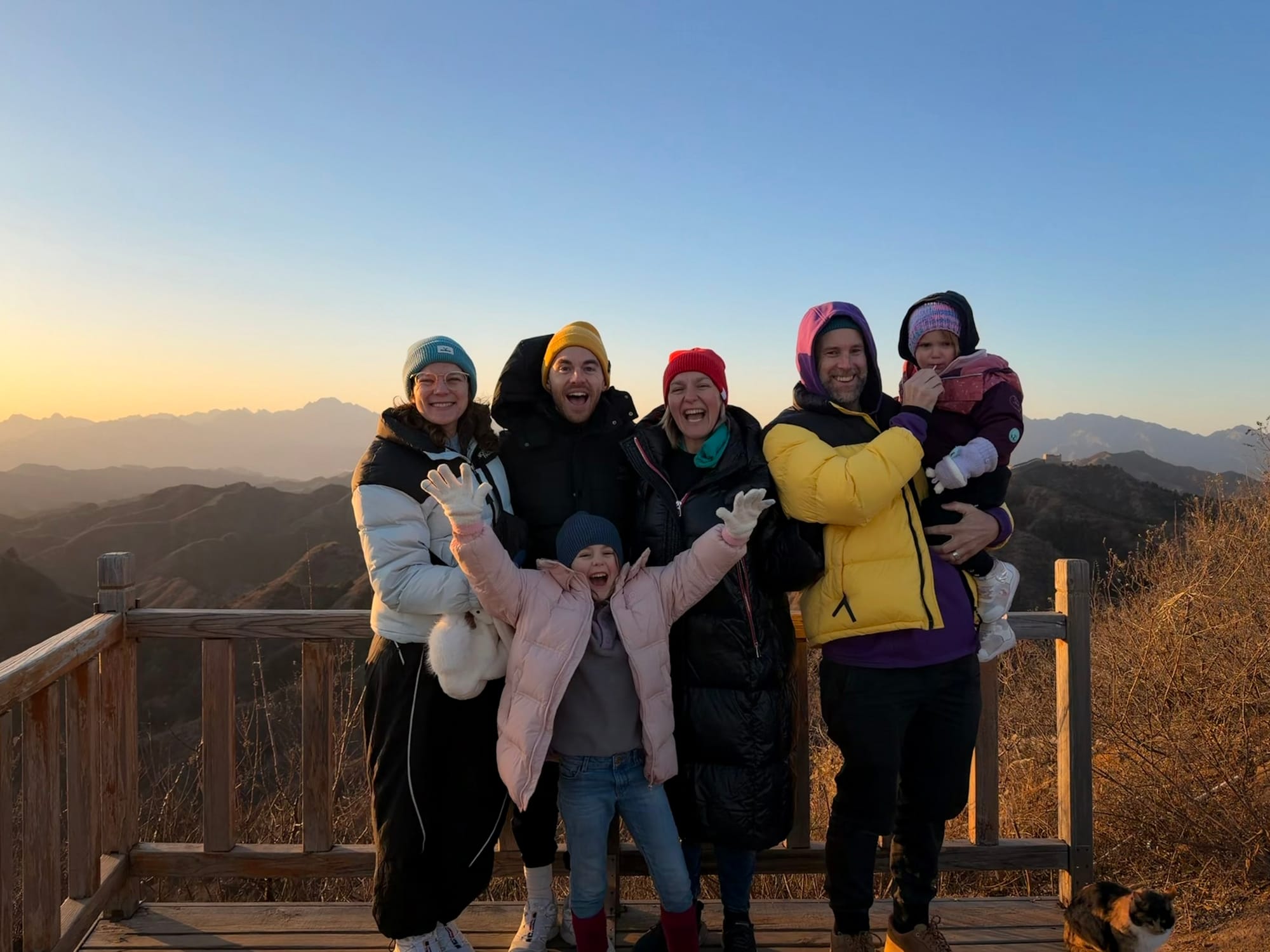
At 5:45am we were hiking up in pitch dark at minus six or seven degrees. A trinket seller materialized out of nowhere in the blackness (“Hello, Hello”) and sold gloveless Glen a $9 pair; a second woman appeared ON the wall at dawn offering coffee. Sunrise from a watchtower, mountains with no towns visible in any direction, which almost never happens in China.
Where the hell did you come from? The Wall just goes on and on and on.
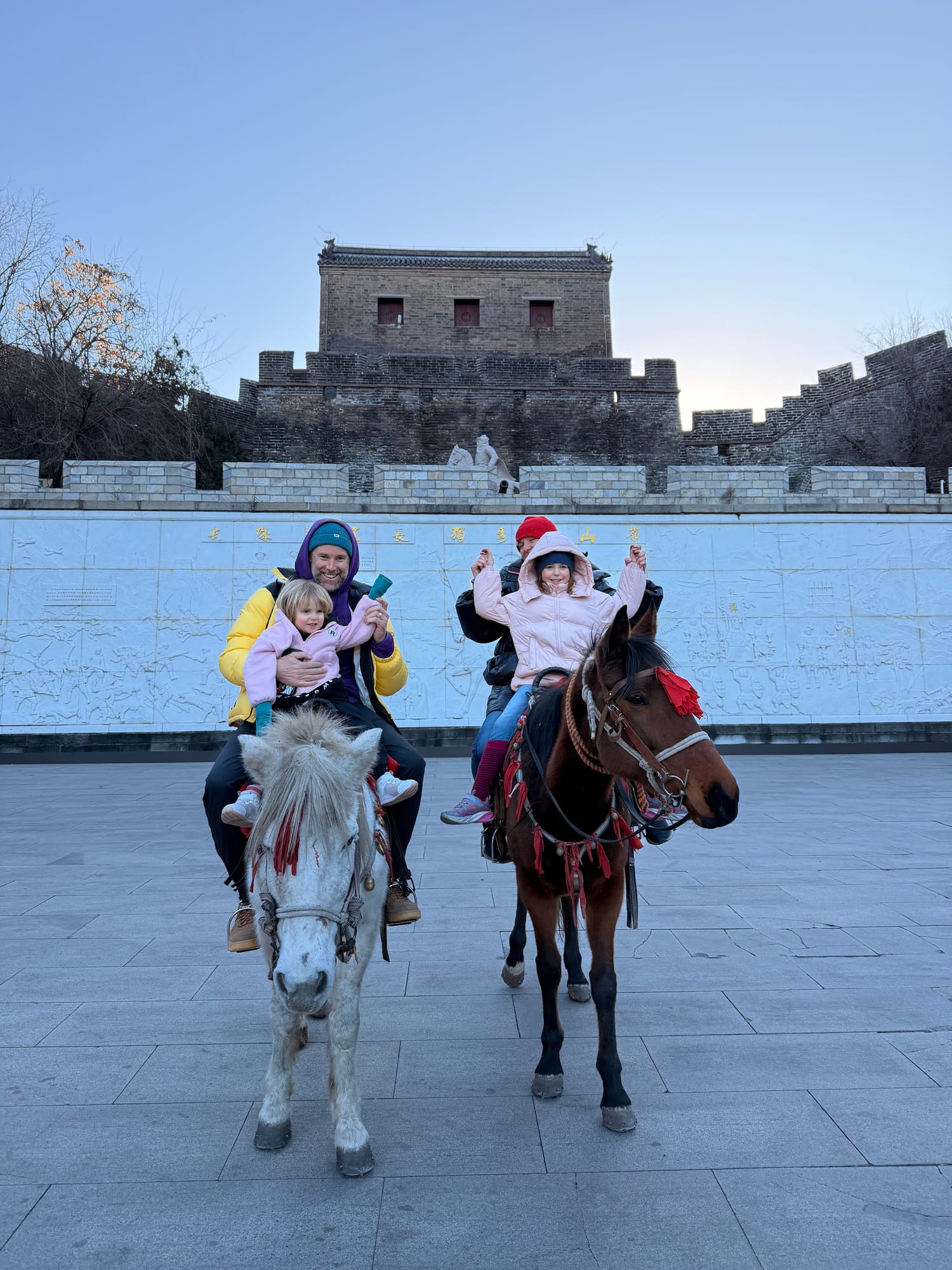
We went back up at 3pm, the kids riding ponies partway, and watched sunset light the opposite side of the same landscape. Two shows in one day on the same stones. Breakfast between them was 50 fresh handmade dumplings and two dozen boiled eggs. Even with expectations fully loaded, the wall beat them: “even knowing all that, it still surpassed my expectations.”
Chapter 06 / 08Day 19 of 31 · 2,900 km to go
Jiangnan
07 · Shanghai, sickness, and the world's #2 barista

Shanghai is China's only international city. Suzhou hides the world's #2 barista.
The Beijing to Shanghai G train covers 1,318 km in four and a half hours, and I slept through most of it with the head cold that had finally caught up with the pace. Before boarding we executed the now-codified station ritual: Beijing South has something like six Starbucks, and our group bought out the sandwich and yogurt stock of two of them. After the Pringles-and-Oreos day, we never boarded a long train unprovisioned again.
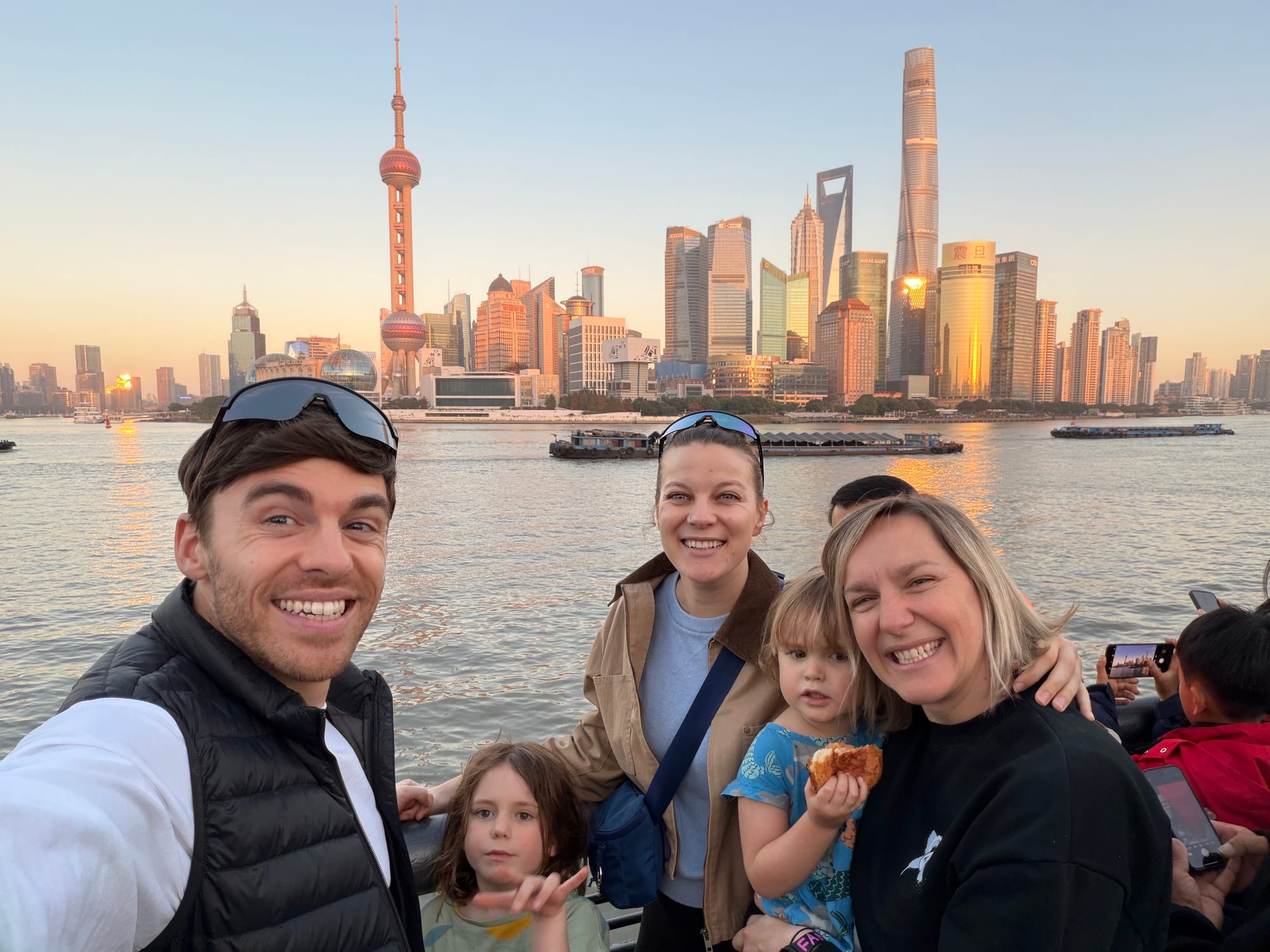
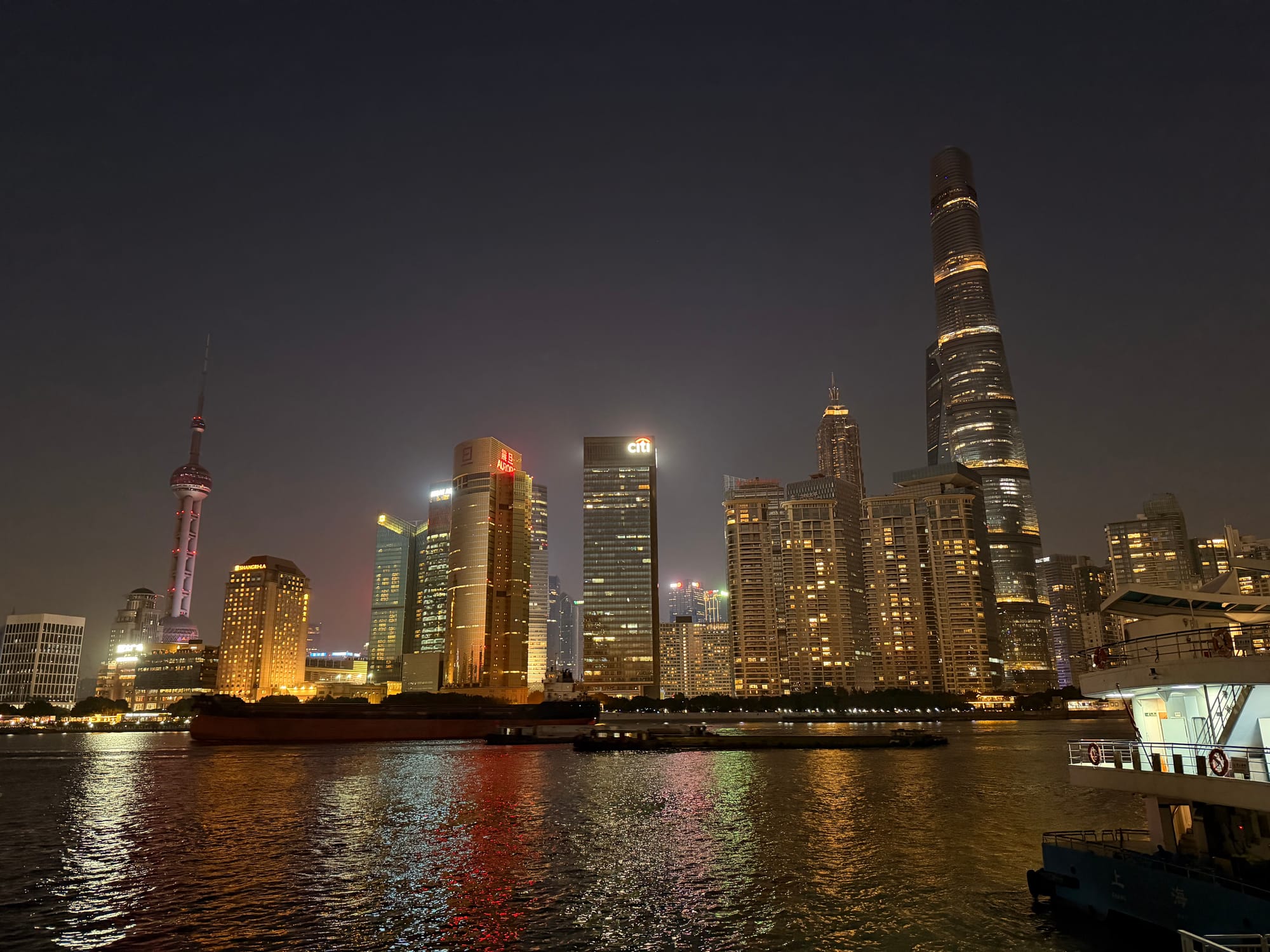
Shanghai was “the first time it felt like a real city,” a big Hong Kong. We stayed cheap in the former French Concession, which was the right trade: crap hotel, beautiful streets. Saturday there was pure vibes: plane trees, brunch, two rounds of specialty coffee, and at a pizza place that night the disorienting realization that everyone around us spoke English. Shanghai is really the only international city in all of China. It is also where the toilet thesis fully formed: world-class cafes with no toilet at all. Locals confirmed the doctrine: “we only pee or poop in either the mall toilets or five star hotels. That’s just how you exist in China.” The Urban Planning Exhibition Center, with its room-sized scale model of the entire city, became an accidental favorite partly for the model, partly for the plumbing.
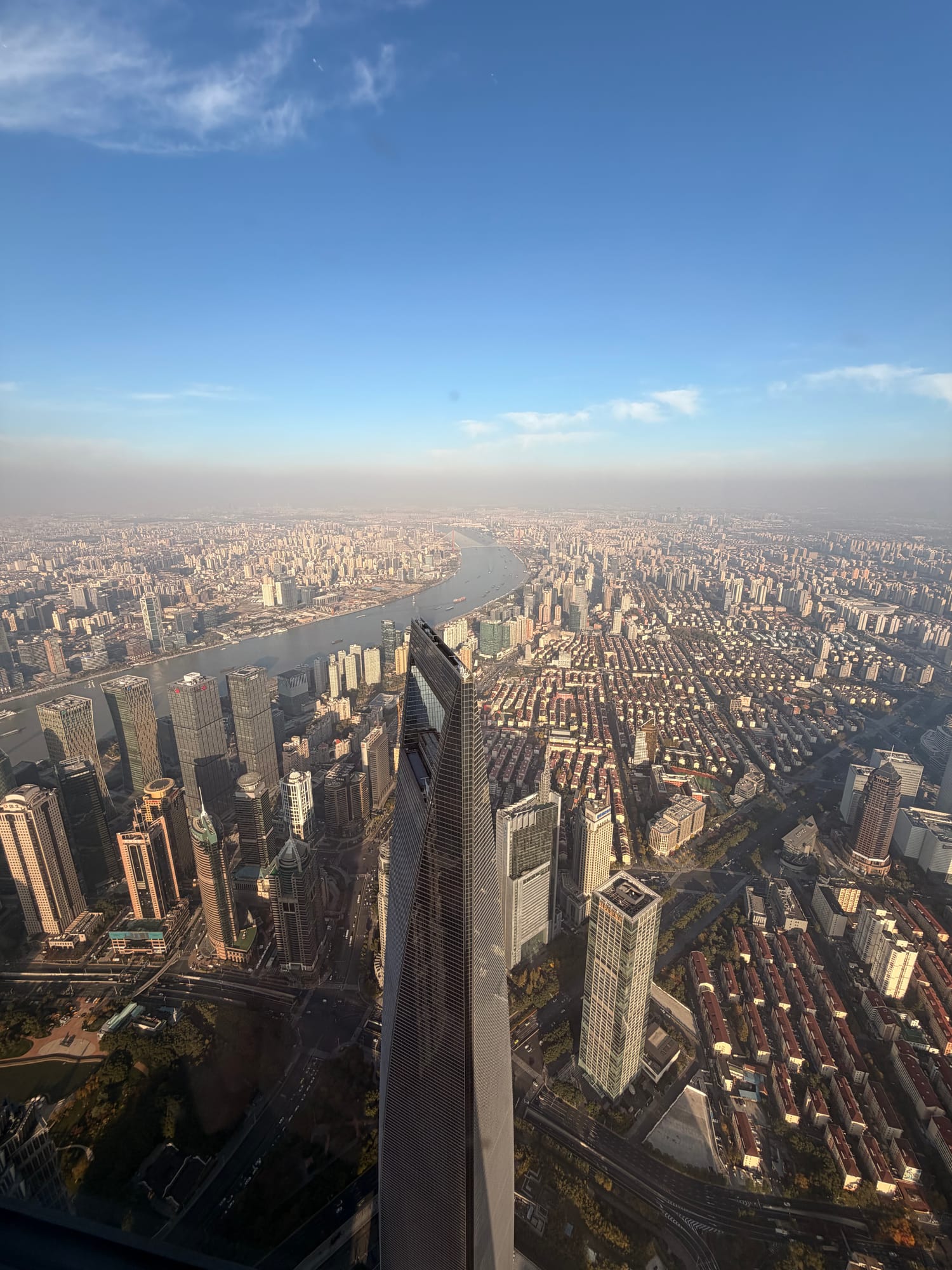
The commerce day was a classic: up Shanghai Tower’s 20-second elevator, dumplings at Paradise Dynasty (one of the handful of best meals of the month), then AP Plaza, the famous fake market, for the closing-time Canada Goose standoff. Opening price $160; I walked out twice; as the market shut she yelled “fine, whatever, let’s do it” at $85. Esme’s $65 Dyson Airwrap replica, vouched for only by an overheard British reseller buying ten more, worked perfectly. We said goodbye to Glen, Jenny and the girls between the fake stalls, which felt about right.
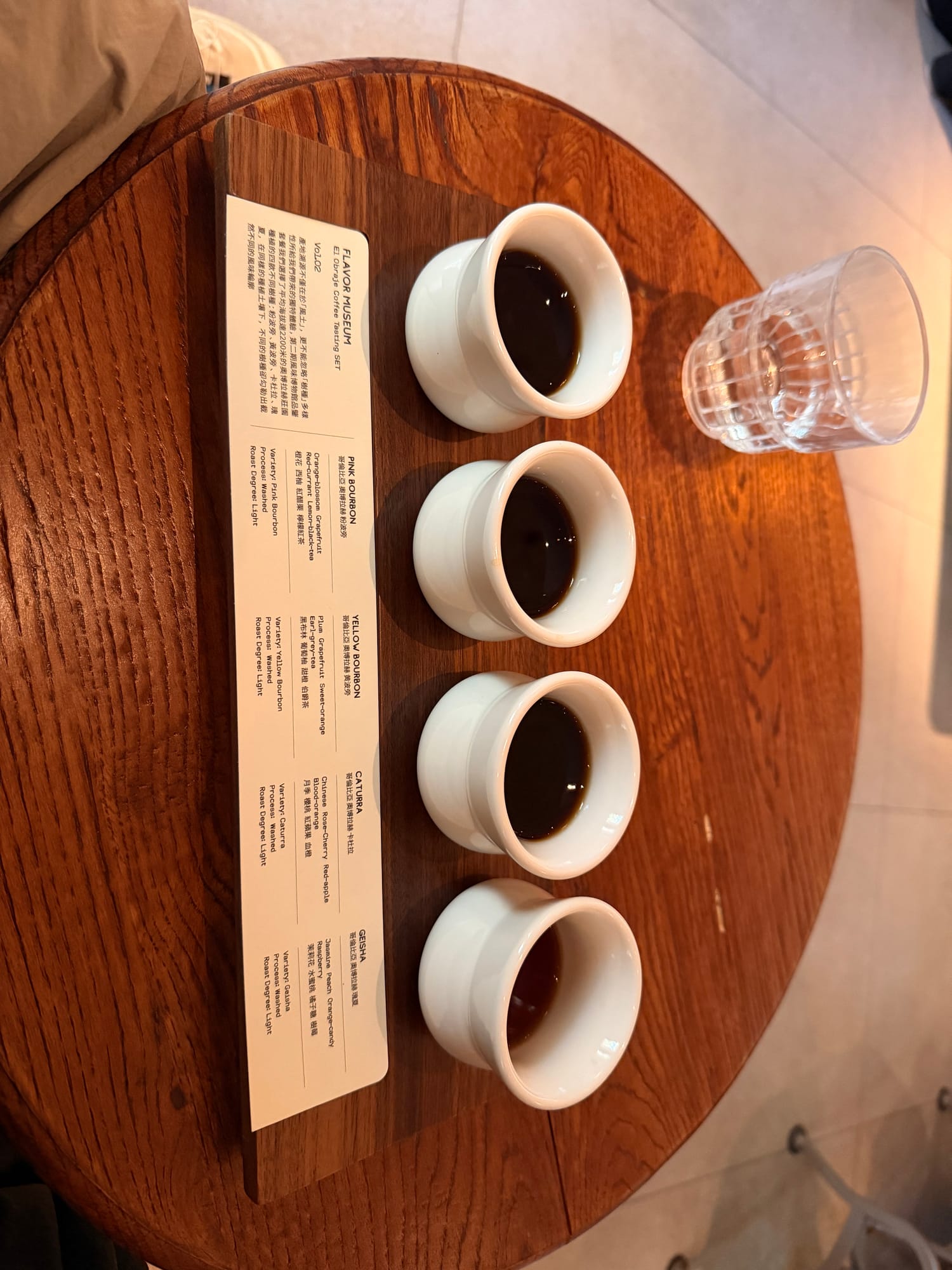
Suzhou, 30 minutes away, was the recovery stop, and it hid the single best coffee moment of my life. An unassuming roadside cafe called Maris is run by the runner-up of the 2025 World Barista Championship, and his ~$30 tasting flight is his actual competition set. The flat white is a blend of cow, coconut and oat milk over a bean with a genuine blueberry kick. Possibly the best flat white I’ve ever had in my life. I see why he came second.
It tasted exactly like a blueberry muffin... it still tasted like coffee.
We also did the Humble Administrator’s Garden, the canal old town, and the Pan Pacific’s included scenic park, and I’d argue Suzhou deserves Marco Polo’s “Venice of the East” title more than Hangzhou does.
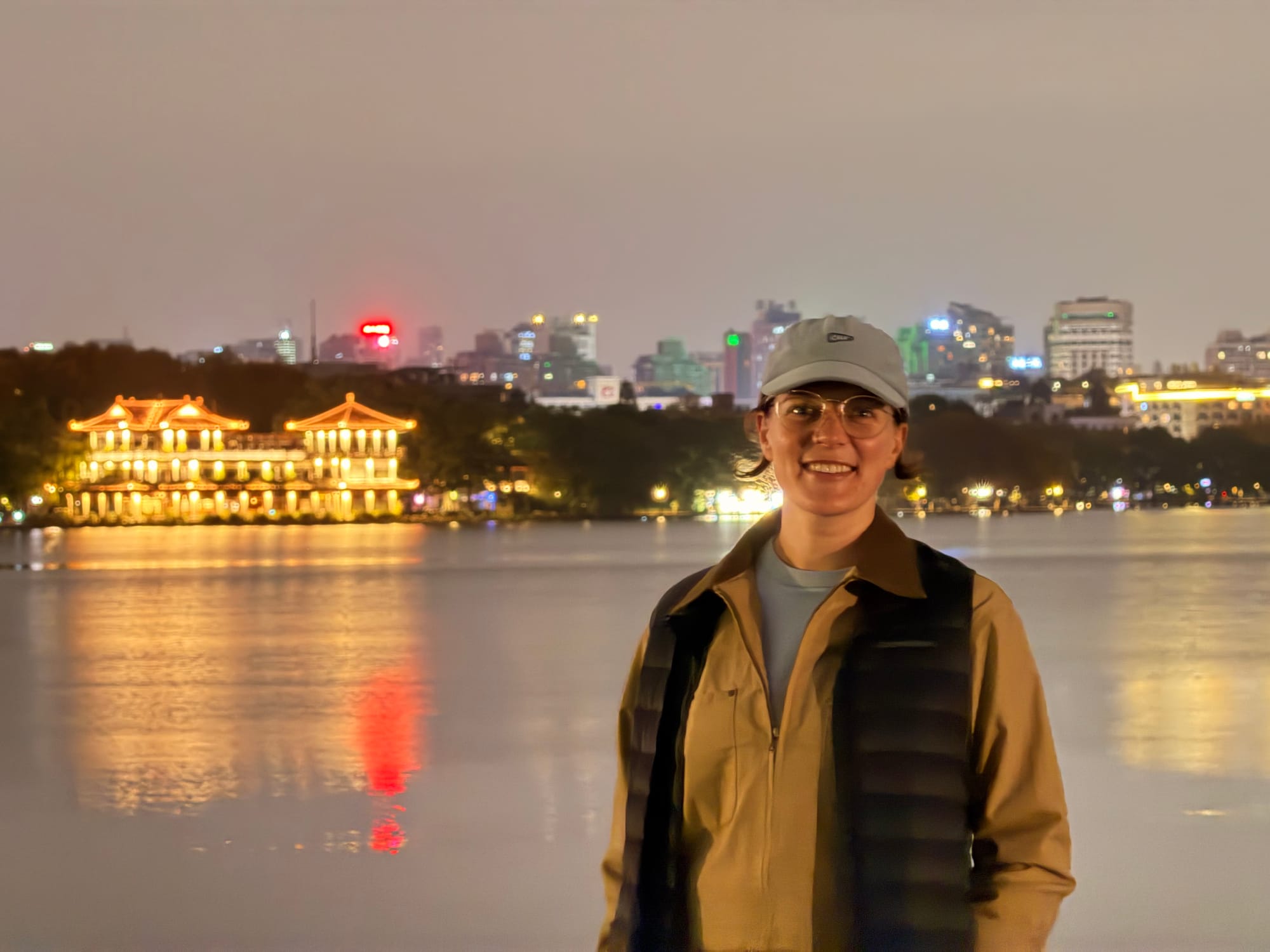
Hangzhou got one day, and West Lake quietly beat Beijing’s Summer Palace at its own game: causeways, autumn color, runners, hills framing the water, young crowds out by the lake at 11pm on a Tuesday. On the way to the airport we hit Freshippo, Alibaba’s supermarket, where groceries fly overhead on ceiling conveyors and residents pay by face scan. Then the evening flight west to Yunnan.
Chapter 07 / 08Day 24 of 31 · 1,900 km to go
Yunnan & the End of the Road
08 · The chill province, then 3,200 m

The leg we'd redo tomorrow: Dali, the gorge at dawn, yak hot pot at 3,200 m.
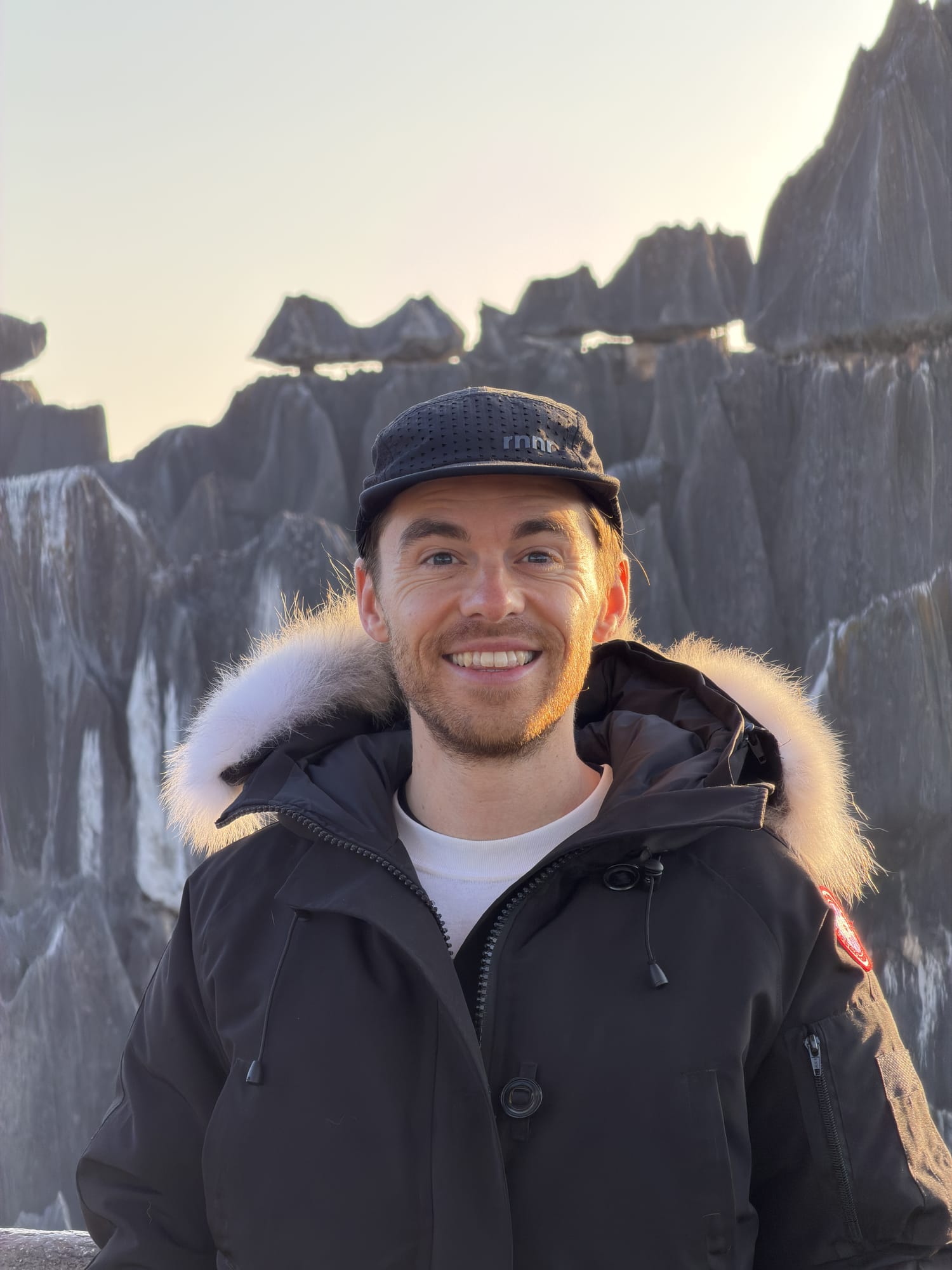
Yunnan is where China exhales. Fruit stalls appeared for the first time (it’s semi-tropical), faces got more varied, everyone had time to chat, and the trains thinned out to a morning and evening departure. We ran the gate-town playbook one last time at the Stone Forest: most expensive Didi of the trip out to Shilin at night, a $20 homestay, and at the 7:30am opening we walked into the visitor center before the staff, lights still off. Three hours of stone labyrinths in sunrise light, dewy grass, the Ashima rock, total silence. At 10:30 the loudspeakers arrived on schedule, every tour leader with the same hip-mounted speaker, “distorted and they turn it up max volume and it’s even more distorted.” We were already leaving.
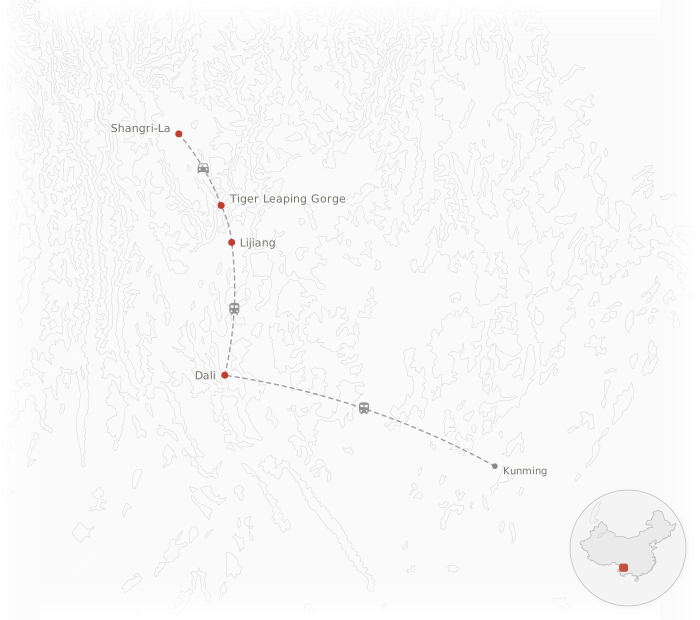
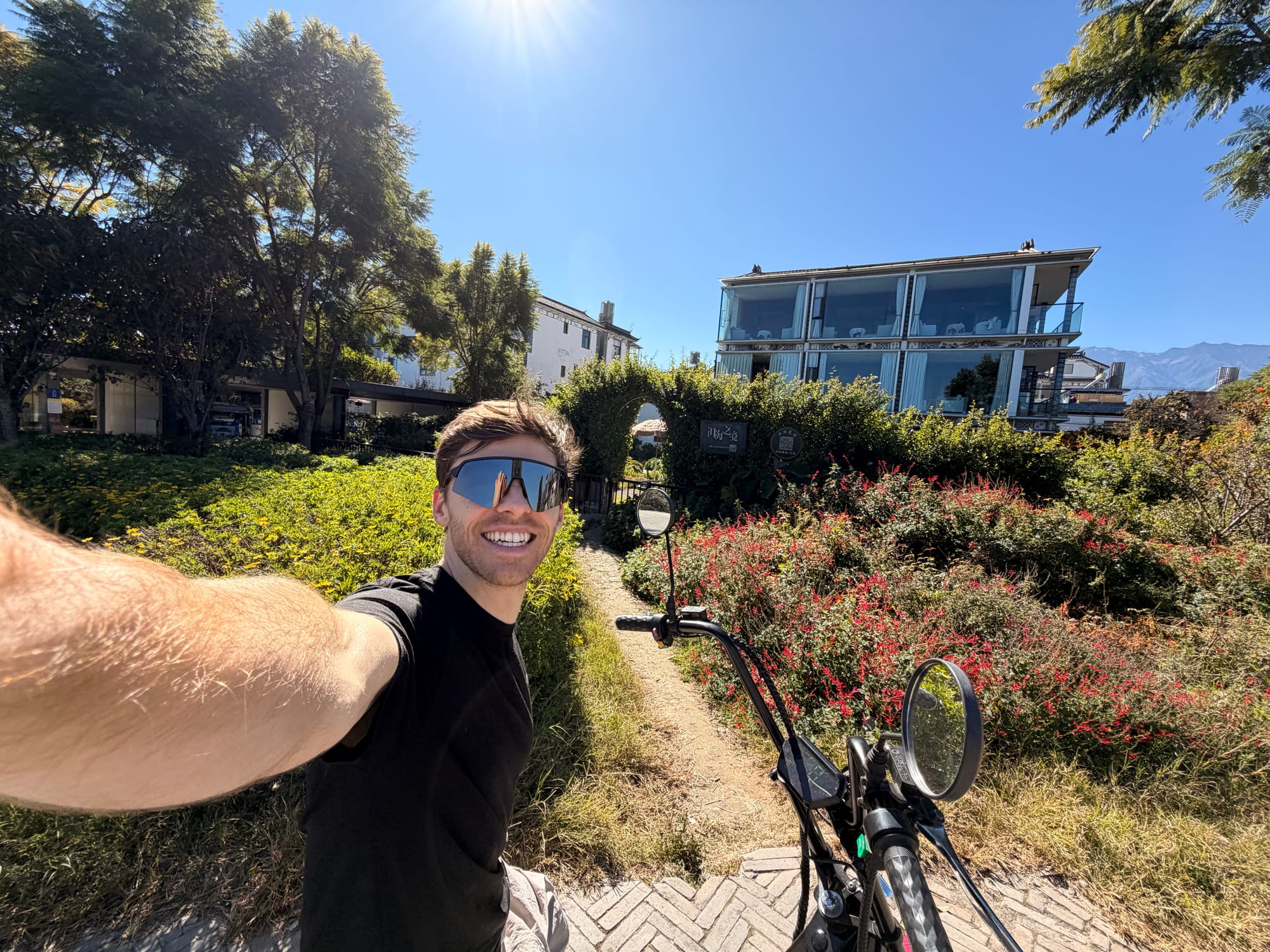
Dali was the favorite place of the whole month. We took a lakeside homestay on Erhai for three nights, our longest stay anywhere, run by a tiny lady with a tiny voice who quietly rewrote the rules of the trip. Foreigners can’t rent the lakeside scooters (Chinese ID and WeChat only), so she rented them under her own name: “I get it. You’re not Chinese. Let me help you.” She A/B-tested our breakfast daily based on what we left uneaten, and started each morning with a text like “Good morning, have you tried Luckin coffee? It is very popular in China. Would you like to try?” My friend Genie, who had just moved to Dali and speaks Chinese, unlocked the rest: stone barbecue in the ancient town, the 6 RMB cafe where everything costs 80 cents, mushroom hot pot that has to boil for 20 minutes before the wild mushrooms are safe, and a fixed-price communal dinner at a nunnery at the foot of Cangshan. We scrambled along Cangshan’s mountainside path past seven waterfalls and caught the last gondola down with nothing to spare.
Dali is also where a lakeside photographer airdropped us a group photo processed by instant filter: skin smoothed, chins sharpened, and hardcore whitening. “Esme and I, we looked like ghosts.” Everyone else was thrilled.
We missed a train out (a bicycle race around the lake closed the only other road, and Didi knew before Apple Maps did), scootered the rest of the lake corridor as compensation, and rolled into Lijiang for tai chi ladies at Black Dragon Pool, a three-cup pour-over lesson where the same coffee tasted wildly different from each cup, and a hotel owner who became our fixer. That mattered, because Tiger Leaping Gorge has the gnarliest logistics in China: four map pins share the name, Didi drivers refuse the route, and the shuttle system runs on WeChat group chats and QR payments to strangers. “You just pay it and hope that something good’s going to happen.”
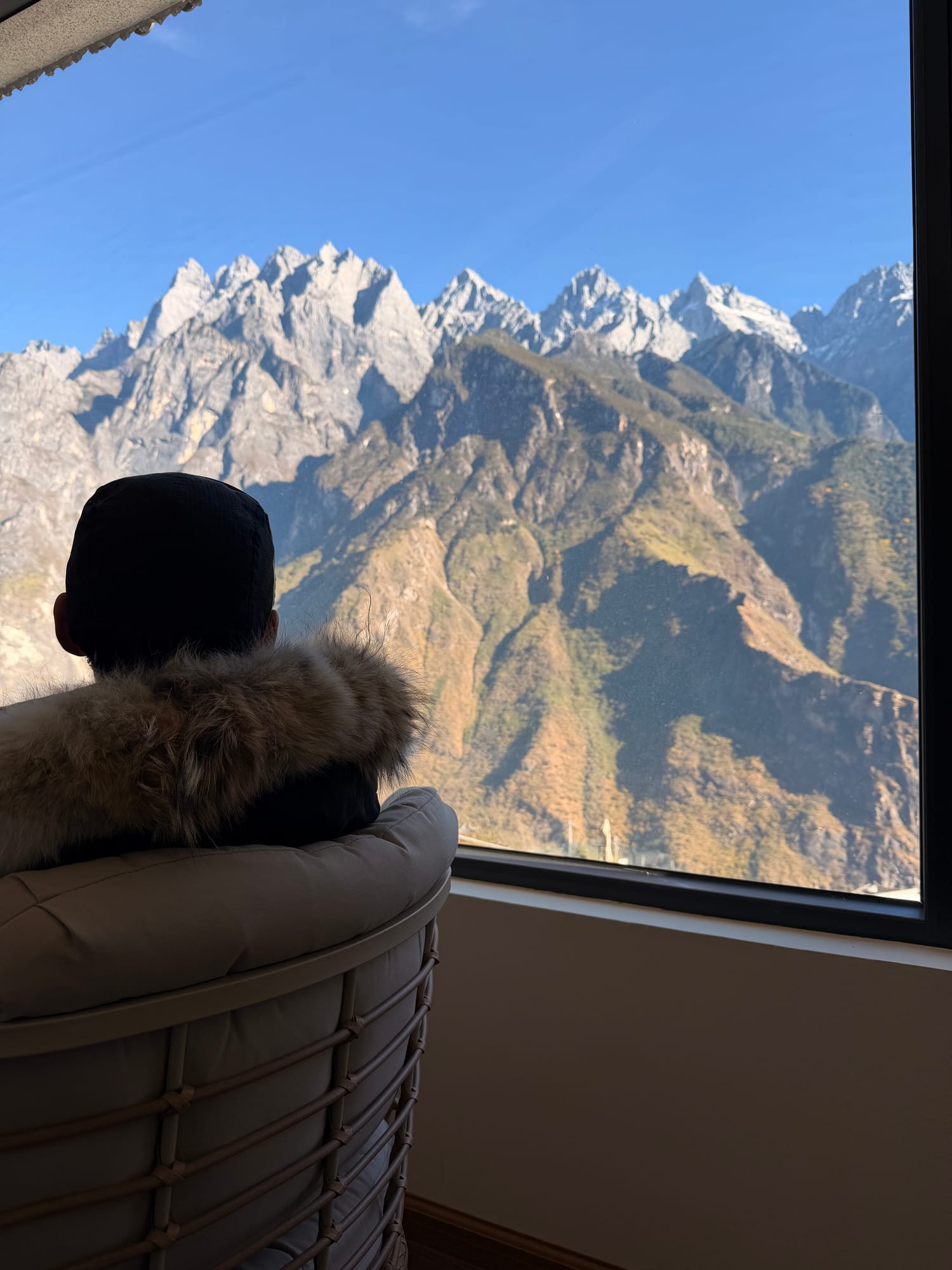
It was worth every hoop. The gorge was the only outdoor place all month without a concrete path, and our guesthouse penthouse looked straight at a sheer wall of mountain. At dawn we had the high trail entirely to ourselves for an hour and twenty minutes, walked with a herd of trained goats, and finished at the Halfway House chalet cafe: fireplace, flat white, apple-pie croissant, and the famous doorless toilets with the best view in China. The ride out was booked as two hours and became a five-hour mystery tour via the White Terraces with a couple from Xi’an who conducted an entire conversation with us over WeChat while sitting next to us, then quietly paid for everyone’s lunch. Offering to pay them back, we learned, would have been the rude move.
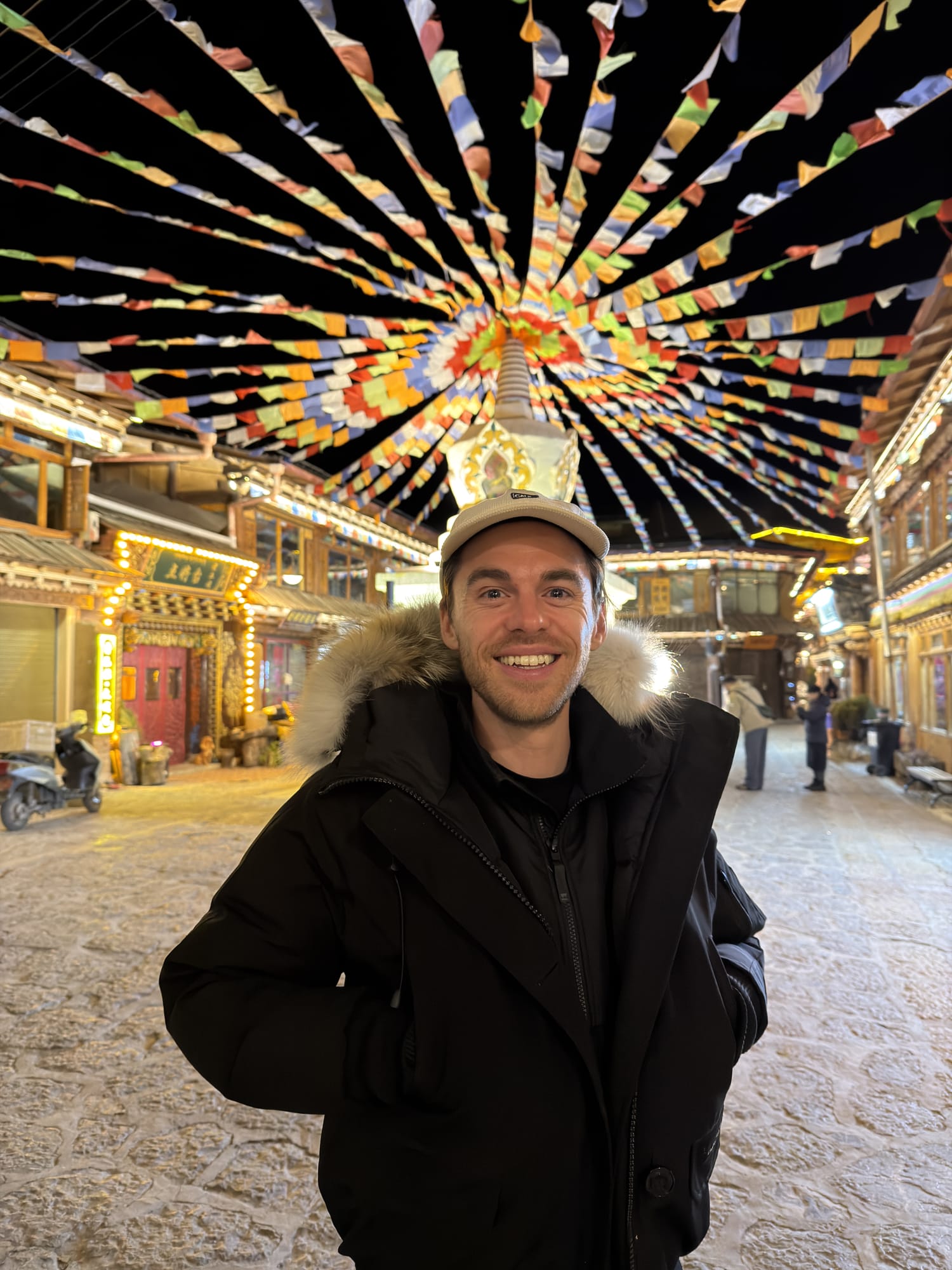
Shangri-La, 3,200 m up on the old edge of Tibet, closed the trip: a closing-time sprint through Ganden Sumtseling monastery (we reached the locker building at literally one minute to six), canned oxygen for sale on every corner, a yak hot pot owner who refused to let us over-order (“the mini is enough,” he was right), and thirty strangers spinning the world’s largest prayer wheel at 10pm. And at the end of the last full night in China, our host appeared with a pot of his own yak milk and a firm opinion about bedtime.
He wouldn't take no for an answer. We were going to have our yak milk.
It was actually pretty yummy. Then day 31, the visa’s hard wall: a 5.5-hour train back to Kunming, a Starbucks feast in lieu of the airport lounge, and a two-hour flight to Bangkok that was shorter than our flight into Yunnan.
Chapter 08 / 08Day 31 of 31 · 0 km to go
Photos
Twenty frames from the month, in order. Two phones, no camera, and a lot of sprinting to trains.
Discoveries
Not the famous stuff. These are the eight places we actually message friends about, with pins.
Macau old town
The one-woman set menu
One chatty lady cooking a four-course Macanese set menu solo. A power cut hit her building mid-meal; she borrowed a countertop gas stove and finished it. And it was great.
Find it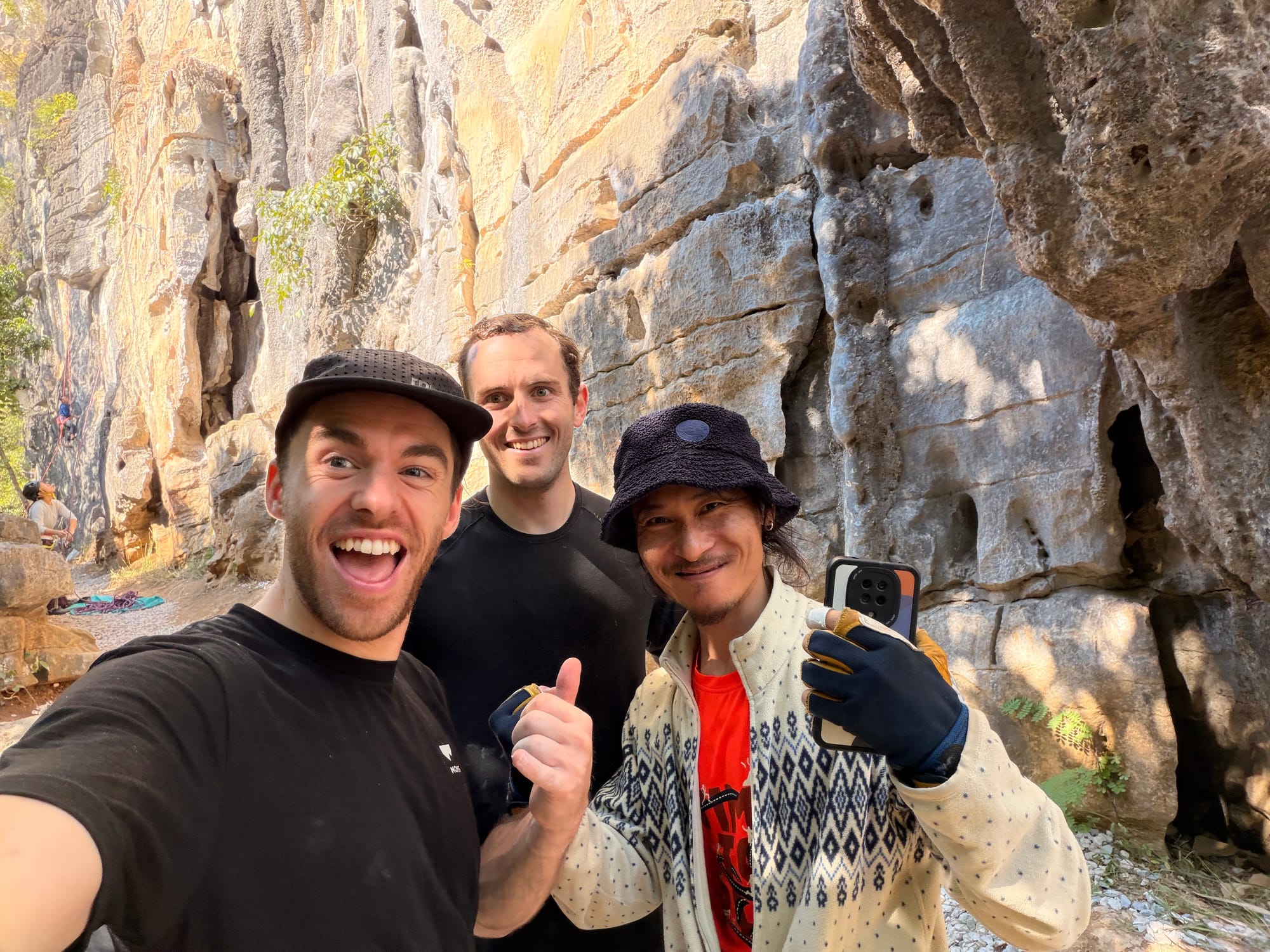
Yangshuo
The $60 climbing day
Book at the climbing shop in town; the owner's English is excellent. Our guide was essentially a Chinese climbing bum who set top ropes under the karst and belayed all morning, gear included.
Find it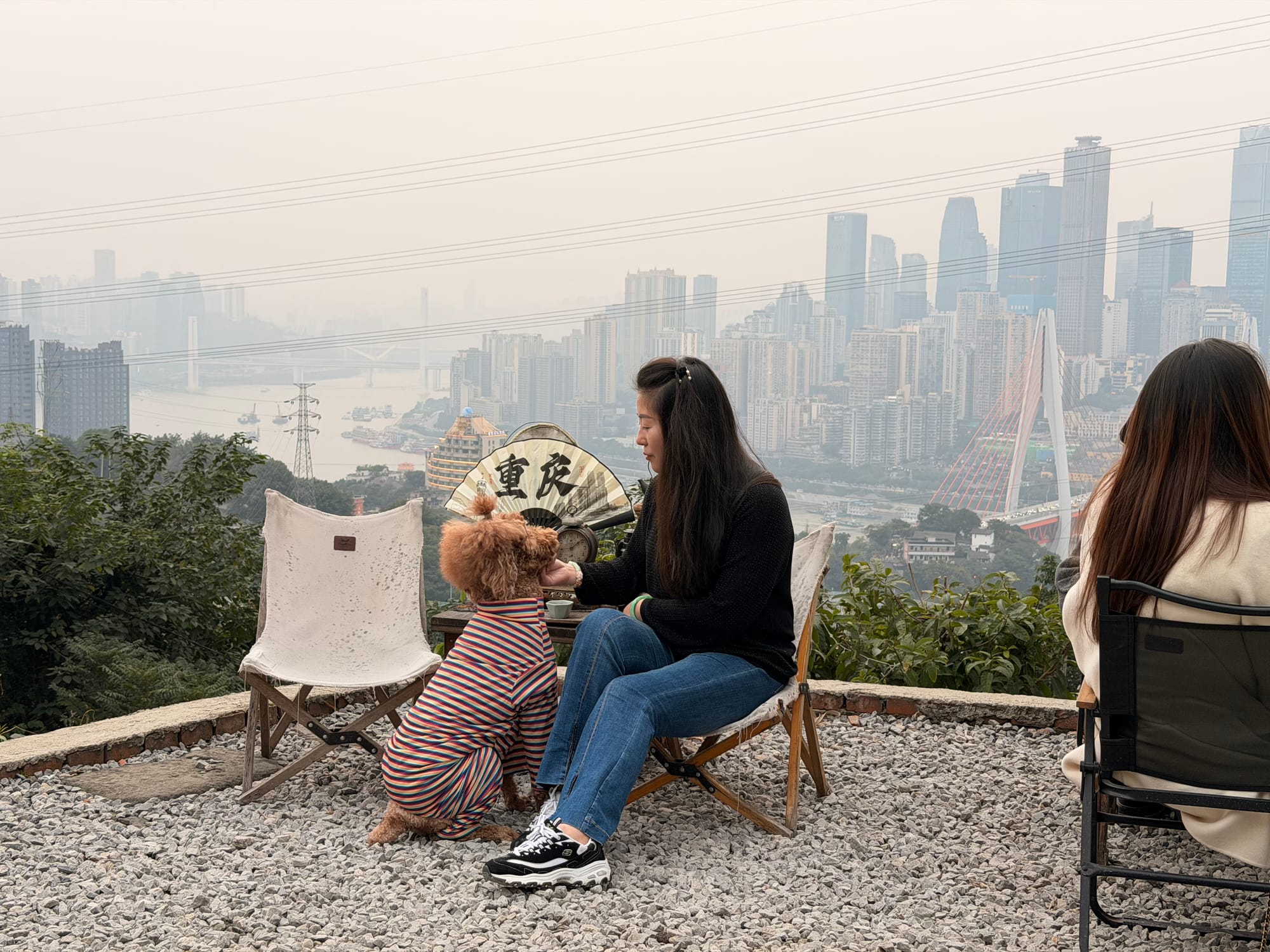
Chongqing
The hilltop tea houses
A steep 15-minute walk above the city. The tea set is mandatory, about $12 a head, and comes with chestnuts, sweet potato and mandarins to grill over coals while the sun goes down.
Find it
Suzhou
Maris Coffee
An unassuming roadside cafe run by the runner-up of the 2025 World Barista Championship. The ~$30 flight is his actual competition set. I see why he came second.
Find it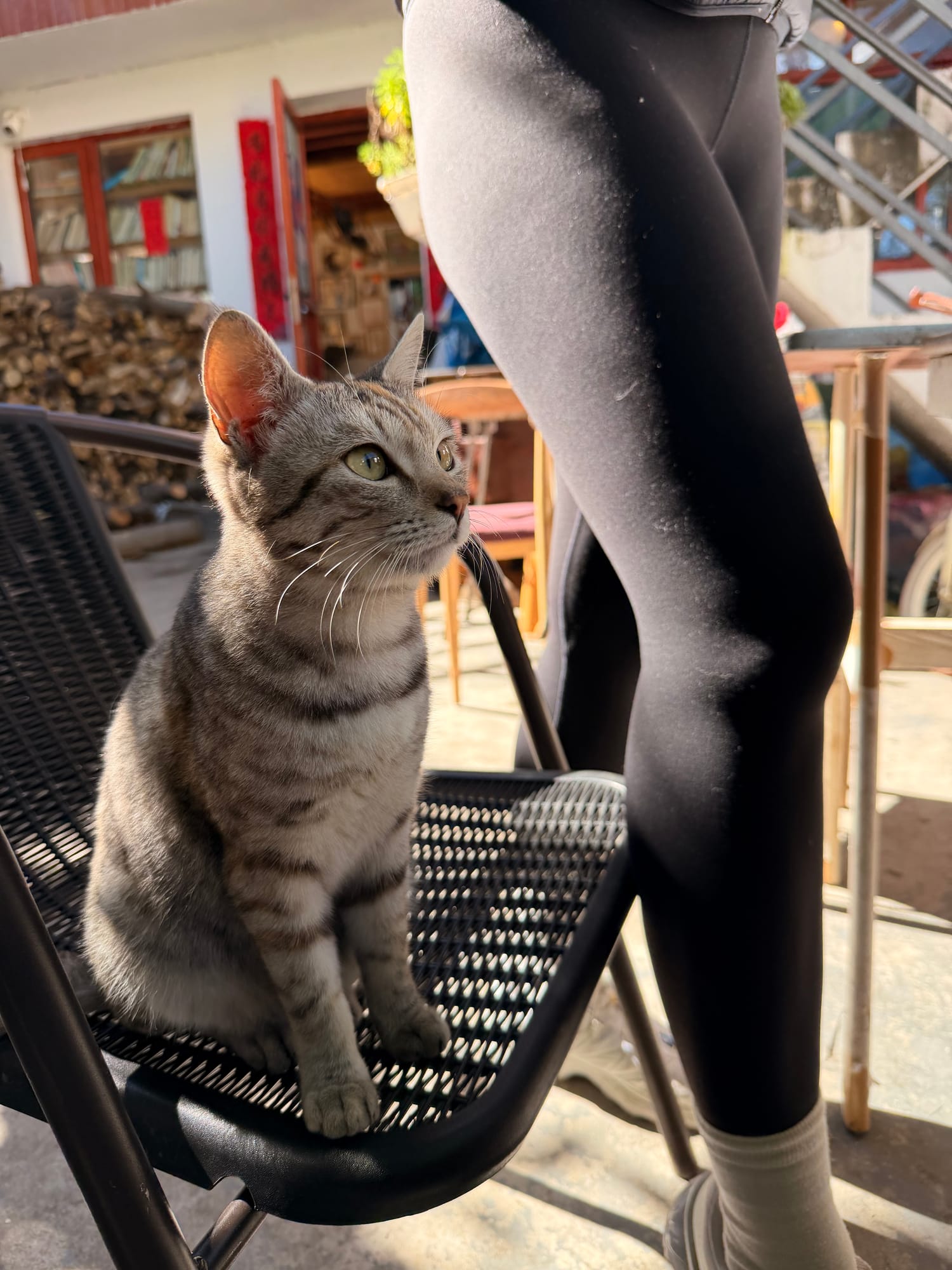
Dali
The 6 RMB cafe
Run by volunteers who work for free accommodation, in a village at the foot of Cangshan. Everything costs 6 RMB, about 80 cents, and the resident kitten has no respect for your coffee or your matcha cake.
Find it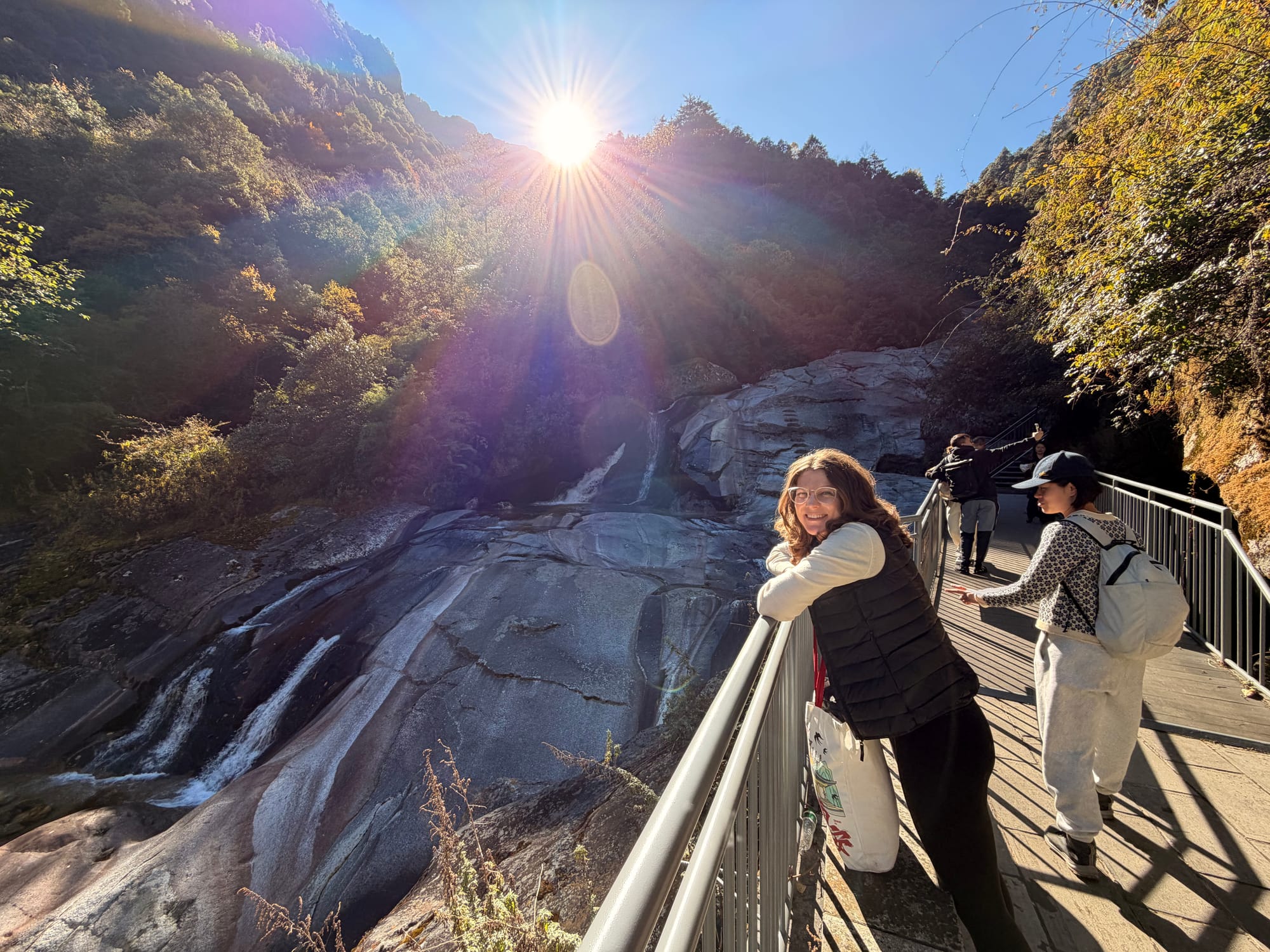
Cangshan, Dali
The nunnery dinner
A fixed-price, help-yourself communal dinner at the nunnery near the gondola base, packed with locals and almost no foreigners. "It must be an open secret because it's really good food and really cheap."
Find it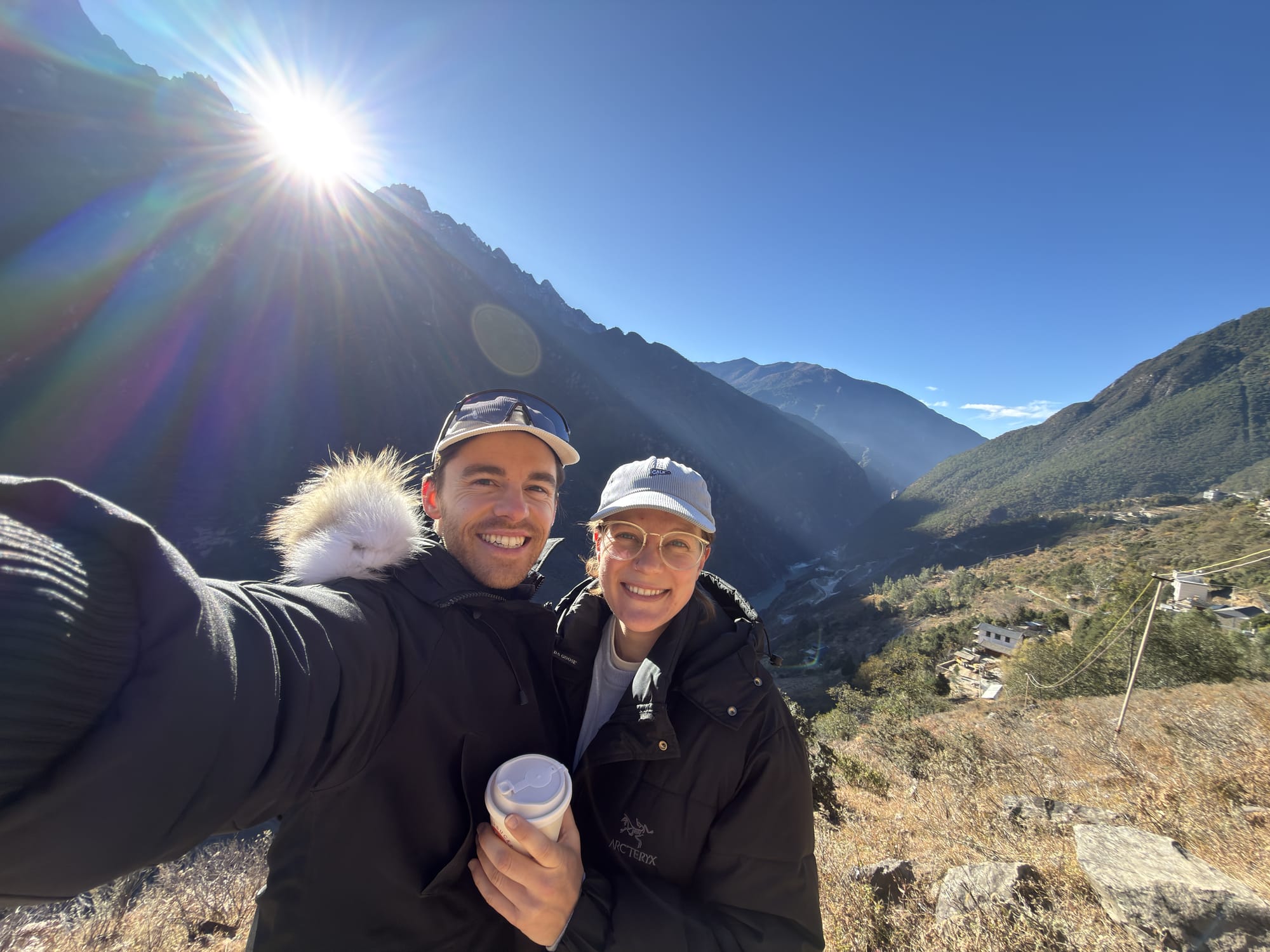
Tiger Leaping Gorge
The Halfway House cafe
A log-chalet cafe on the high trail: lit fireplace, a genuinely good flat white, an apple-pie croissant, and the famous doorless toilets with the best view in China. Go at dawn, before the vendors unzip their gazebos.
Find it
Shangri-La
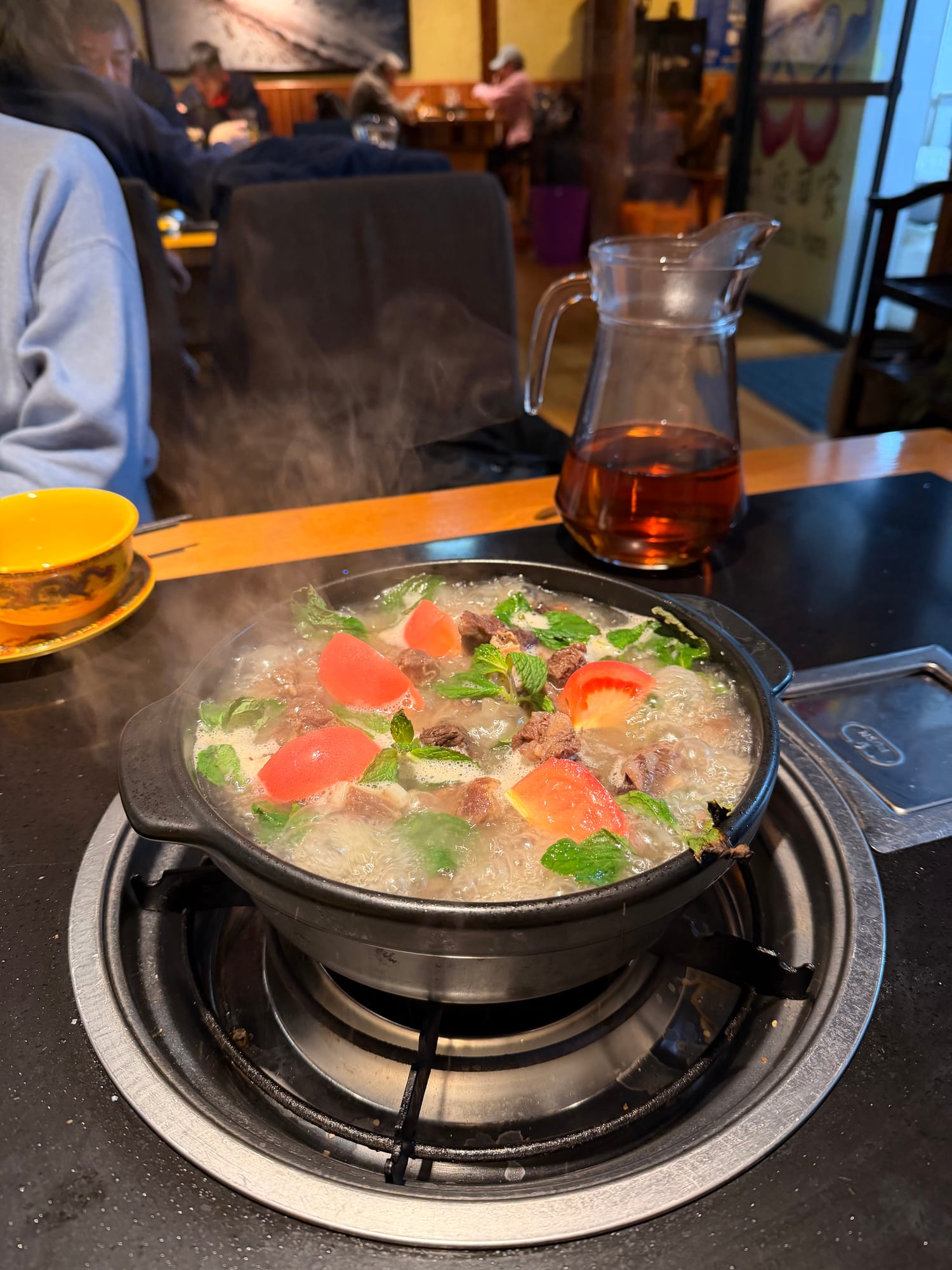
The yak hot pot
4.9 stars on Dianping, an owner who orders for you and refuses to let you over-order. "The mini is enough." He was right, and the yak yogurt is the dessert.
Find itWhat China Actually Costs
China in November 2025 was the best value travel either of us has ever done. The month averaged out around $77 a night for accommodation, and that bought penthouses, garden hotels and homestays with concierge-grade hosts.
| Thing | What we paid | Notes |
|---|---|---|
| Visa | $0 | 30 days visa-free for many Western passports. The 30 days is a hard wall; it set our trip length. |
| Hotels | ~$77/night average | Five-star Macau $100; 70 m² Chongqing penthouse ~$70; Huashan homestay $16; Shangri-La heated suite ~$70. Scroll to the bottom of listings: the biggest room is often ~$65. |
| High-speed rail | ~6,000 km total | G trains are the newest and fastest (300+ km/h); C trains serve smaller cities. Tickets tie to your passport; book on Trip.com. |
| Didi | A few dollars per hop | The ride-hailing app that replaces taxis everywhere. ETAs are scarily accurate. Pins for hotels are often wrong; expect a short walk. |
| Food | $7-40 for two or three | $7 fed three of us in Wulingyuan. The ~$40/head five-star buffet was the expensive outlier and worth it. |
| Scooters | ~$4-5/day | Speed-capped for tourists. Lakeside rentals in Dali need a Chinese ID, so ask your host to book. |
| Fakes | $18-90 | AirPods $18, North Face $20-25, Canada Goose $85, Dyson Airwrap $65. Aim for 25-30% of the opening price in tourist markets. |
The systems, briefly:
Payments. WeChat Pay and Alipay work with foreign cards now, and you’ll use them for everything. The catch: people can pay you nothing back. A scooter deposit returned in cash gave us 400 yuan we could barely spend for three weeks. “They cannot pay you. You can only pay people.”
Internet. The usual suspects are blocked. Set up a VPN before you land, and expect your AI tools to hallucinate Chinese restaurants: ChatGPT and Gemini both invented places that didn’t exist. Dianping (the local Yelp) plus a translate app is the real stack.
Trains. Stations are enormous, security is fast, and gates close 3-5 minutes before departure. Buy food before boarding: station Starbucks for sandwiches, Lawson’s or 7-Eleven for crackers. Foreigners use the staffed passport gates at the edges.
Batteries. Battery packs without the CCC (China Compulsory Certification) logo cannot fly domestically, which in practice means every foreigner’s battery gets confiscated. Airports have piles of them. Argue if you like; I did; they have printouts of the law.
Flights. Trip.com again. Internal airlines threaten strict 5 kg carry-on limits; nobody weighed ours, but don’t bet a drone on it.
By the Numbers
Useful Links
- Trip.com - hotels, all trains, and internal flights in one app; free cancellation made our constant replanning painless. It’s Ctrip, the Chinese giant, in English.
- China’s visa-free transit and entry policies (National Immigration Administration) - check your passport’s current window before booking anything; the rules have been expanding but they change.
- China Railway 12306 - the official rail booking site. You can book here directly, but Trip.com wraps the same inventory with less pain; 12306 is useful for checking real schedules.
- DiDi - the ride-hailing app. Set it up with an international card before you land.
- Dianping - the food-discovery app that actually works (Chinese-only interface; translate your way through). ChatGPT and Gemini hallucinate Chinese restaurants; Dianping doesn’t.
- Amap (Gaode) - the local mapping app; more accurate than Apple Maps for small roads and business locations, especially outside the big cities.
- The China Playbook - the practical layer of this guide on one page: the visa window, Trip.com, Didi, payments, trains, hotels, and the battery rule.